




4th Edition
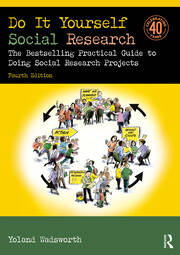
Do It Yourself Social Research The Bestselling Practical Guide to Doing Social Research Projects
Foreword to the first edition
Preface to this edition
Acknowledgements
INTRODUCTION
1. Who and what this book is for
Who is it for?
What you want it for
Who might find this book useful
What you thought of first
Some common apprehensions about Research with a capital ‘R’
BEFORE YOU START
2. What is social research?
What is knowledge and how do we know?
Why do we agree?
Ten rules of the research game
List 2 Summary of the 10 Rules of Research [this entry TBC]
WHERE TO START
3. Why do you want to do it?
Stakeowners and stakeholders in social research: Setting the ethical compass
Clarifying the purposes of the research
To summarise
HOW TO TACKLE IT
4. Managing, timing, budgeting and some common mistakes to avoid
Think about timing
Think about the resources you have
Now think about overall management
Finally, think about money
To summarise
DESIGNS, METHODS AND TECHNIQUES
5. How to go about ‘finding out’
PART A: RESEARCH DESIGN
Introduction - Getting a good research design methodology
A worked example of getting a good research design
This is what the group’s research design looked like…
In summary – Research design example
And now for your own research design ...
PART B: METHODS FOR ‘FINDING OUT’
Introduction: Choosing methods to build your methodology design
Technique A: Identifying purposes, clarifying issues and values, and goal-setting procedures
Technique B: Individual interviews
Technique C: Group interviews
Technique D: Narrative, dialogue and recursive questioning
Technique E: Questionnaires and interview schedules
Technique F: Sampling
Technique G: Participating and observing (fieldwork)
Technique H: Audio-visual methods
Technique I: Written records, accounts and diaries
Technique J: Case studies
Technique K: Social indicators and outcome indicators
Technique L: Surveys
Technique M: Use of computers
Technique N: Community needs studies
Technique O: Evaluation
Technique P: Action research as an integrating ‘full-cycle’ methodology
OTHER RESOURCES
6. Other possible resources
Resource Q: Funding
Resource R: Experienced researchers
Resource S: The literature
Resource T: Statistics
Resource U: The internet
WORKING OUT WHAT YOU FOUND OUT
7. Interpretation and organising ideas
Interpretation
Analysis and synthesis
SAYING WHAT YOU FOUND OUT
8. Getting your findings into action
What we want to achieve
Who we want to tell and why
How to present the findings
The written report
Telling and showing
When to present findings
Follow-up into action
Keeping going
EXAMPLES
Appendix A. Some examples of good do it yourself social research
Introduction to the examples
1. The Women’s Community Research Group project: ‘What have you been doing all day’
2. The local government Children’s Needs Study
3. The Nursing Federation’s study of child health care community nursing: Let’s Communicate
4. Improving a country rail line using a passenger survey: A Railworker’s Plan
5. A chronic disability organisation’s research and development with its clients: A self-help experiences exchange
TRANSLATIONS
Appendix B. Translations of some common research language
SOME READING
Short bibliography of more or less accessible research books and papers for further reading
Books
Journals
Biography
Yoland Wadsworth is a pathbreaker in research methodology and its use in social research in health, community and human services for over forty years. She has been an applied sociologist and consultant to community-based non-government organisations, self-help groups, and state, federal and local governments; an Adjunct Professor in the Centre for Applied Social Research, RMIT University; Principal Fellow in the McCaughey VicHealth Centre for Mental Health and Community Wellbeing, University of Melbourne; and deputy to the Director of the Policy & Research Branch in Premier & Cabinet, Victorian government. She is also author of the best-selling Everyday Evaluation on the Run (Vol 2 in this 40th anniversary Routledge trilogy) and culminating magnum opus, Human Inquiry for Living Systems: Building in Research and Evaluation for Life (Vol 3 in this same Routledge trilogy).
‘Yoland Wadsworth’s Do It Yourself Social Research is one of the most remarkable products of Australian social science. Practical, sophisticated, ... I know of nothing else that is half as good.’
R.W. Connell, Professor of Education, University of Sydney
‘ . . . incredibly useful . . .’
Elizabeth Reid, United Nations Development Programme, New York
‘It raised my view of research from ‘‘something I have to do’’ to ‘‘something I want to do’’.’
First-year university student
