





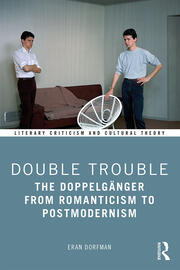
1st Edition
Double Trouble The Doppelgänger from Romanticism to Postmodernism
Biography
Eran Dorfman is Associate Professor and Head of the Department of Literature at Tel Aviv University, and a former Directeur de programme at the Collège International de Philosophie, Paris. He is the author of Foundations of the Everyday: Shock, Deferral, Repetition (Rowman & Littlefield International, 2014); Learning to See the World Anew: Merleau-Ponty Facing the Lacanian Mirror (Phaenomenologica series, Springer, 2007, in French); and the co-editor of Sexuality and Psychoanalysis: Philosophical Criticisms (Leuven University Press, 2010).
"The double is not the same. This is the lesson of Double Trouble, which revises and expands the concept of the double into a theory of multiple identity. It is actually two books in one, a biographical essay and a theoretical essay, which resonate with one another, producing allegorical sparks. This doubled book is a fascinating new entry on a topic that may well be the key to modern European thought."Paul North, Yale University
"Double Trouble provides subtle and sophisticated readings of a wide-ranging variety of literary and theoretical resources, along with soul-searching reflections on personal experience. Particularly, it addresses the issue of the double in a way that does not stop with academic speculation, but demands that the reader confront the practical implications of these reflections."
Duane H. Davis, University of North Carolina
