





1st Edition
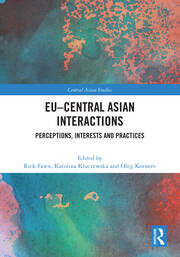
EU–Central Asian Interactions Perceptions, Interests and Practices
Preface
Rick Fawn, Karolina Kluczewska and Oleg Korneev
1. EU–Central Asian interactions: perceptions, interests and practices
Rick Fawn, Karolina Kluczewska and Oleg Korneev
2. The EU’s Central Asia policy: no chance for change?
Shairbek Dzhuraev
3. Learning in, about and from the field? Symbolic functions of EU knowledge production on Central Asia
Oleg Korneev and Karolina Kluczewska
4. ‘Not here for geopolitical interests or games’: the EU’s 2019 strategy and the regional and inter-regional competition for Central Asia
Rick Fawn
5. The interplay of narratives on regionness, regionhood and regionality: European Union and Central Asia
Selbi Hanova
6. The EU and China: how do they fit in Central Asia?
Svetlana Krivokhizh and Elena Soboleva
7. Bridge or base? Chinese perceptions of Central Asia under Europeanisation
Pengfei Hou
8. Opportunity and threat perceptions of the EU in Kazakhstan and Kyrgyzstan
Zhanibek Arynov
9. Overlap with contestation? Comparing norms and policies of regional organizations in the post-Soviet space
Alessandra Russo and Andrea Gawrich
10. European Union, civil society and local ownership in Kyrgyzstan: analysing patterns of adaptation, reinterpretation and contestation in the prevention of violent extremism (PVE)
Chiara Pierobon
11. The EU and European transnational companies in Central Asia: relocating agency in the energy sector
Gian Marco Moisé and Paolo Sorbello
12. Communal self-governance as an alternative to neoliberal governance: proposing a post-development approach to EU resilience-building in Central Asia
Fabienne Bossuyt and Nazima Davletova
Biography
Rick Fawn is Professor of International Relations at the University of St Andrews, United Kingdom. He has researched on Central Europe, the Balkans, Russia, the Caucasus, and Central Asia, and has given numerous invited briefings and keynote addresses internationally. His other books include Castle on a Hill: The Visegrad Group, Regionalism, and the Remaking Europe (2024).
Karolina Kluczewska is Postdoctoral Researcher at the Ghent Institute for International and European Studies, Ghent University, Belgium, and Research Associate at the Institute of Middle East, Central Asia and Caucasus Studies, University of St Andrews, United Kingdom. Her research explores development politics and international interventions in Eurasia.
Oleg Korneev is Associate Professor at the School of International Affairs, Higher School of Economics (HSE University, Moscow) and Associate Research Fellow at the Centre for European and Eurasian Legal Studies, Lobachevsky University, Nizhny Novgorod, Russia. His research focuses on international organizations, the European Union, expert knowledge, global and regional migration governance, international action against HIV/AIDS in Eurasia.
“Unpacking the black boxes of the ‘EU’ and ‘Central Asia’, this volume provides a rich account of interactions between both regions. It contributes significantly to ongoing efforts of decentring, pluralizing and decolonizing EU studies through careful examination of how NGOs, grassroots organizations, neighbourhood units such as the mahalla, scholars, businesses and other actors engage within the European-Central Asian space.”
Jan Orbie, Ghent University, Belgium
“EU–Central Asian interactions: perceptions, interests and practices systematically examines the seriously neglected topic of the EU’s relationships with central Asia. The book’s significance is in its broadening and deepening of our understanding of the dynamics of the Europe’s engagement with the region. Bringing together a superb collection of contributors, the volume challenges past thinking while opening new avenues for explaining and understanding the landscape of Europe’s relationship with Central Asia.”
Richard G. Whitman, University of Kent, UK
