





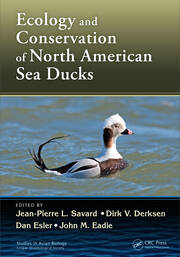
1st Edition
Ecology and Conservation of North American Sea Ducks
Status and Trends of North American Sea Ducks: Reinforcing the Need for Better Monitoring; Timothy D. Bowman, Emily D. Silverman, Scott G. Gilliland, and Jeffery B. Leirness
Phylogenetics, Phylogeography, and Population Genetics of North American Sea Ducks (Tribe: Mergini); Sandra L. Talbot, Sarah A. Sonsthagen, John M. Pearce, and Kim T. Scribner
Population Dynamics of Sea Ducks: Using Models to Understand the Causes, Consequences, Evolution, and Management of Variation in Life History Characteristics; Paul L. Flint
Infectious Diseases, Parasites, and Biological Toxins in Sea Ducks; Tuula E. Hollmén and J. Christian Franson
Dealing with Deficits: Breeding Costs, Nutrient Reserves, and Cross-Seasonal Effects in Sea Ducks; Ray T. Alisauskas and Jean-Michel Devink
Metals and Trace Elements, Petroleum, Organic Pollutants, and Radiation in Sea Ducks; J. Christian Franson
Foraging Behavior, Ecology, and Energetics of Sea Ducks; Ramūnas Žydelis and Samantha E. Richman
Variation in Migration Strategies of North American Sea Ducks; Margaret R. Petersen and Jean-Pierre L. Savard
Remigial Molt of Sea Ducks; Jean-Pierre L. Savard and Margaret R. Petersen
Site Fidelity, Breeding Habitats, and the Reproductive Strategies of Sea Ducks; Mark L. Mallory
Breeding Systems, Spacing Behavior, and Reproductive Behavior of Sea Ducks; John M. Eadie and Jean-Pierre L. Savard
Harvest of Sea Ducks in North America: A Contemporary Summary; Thomas C. Rothe, Paul I. Padding, Liliana C. Naves, and Gregory J. Robertson
Habitats of North American Sea Ducks; Dirk V. Derksen, Margaret R. Petersen, and Jean-Pierre L. Savard
Conservation of North American Sea Ducks; W. Sean Boyd, Timothy D. Bowman, Jean-Pierre L. Savard, and Rian D. Dickson
Conclusions, Synthesis, and Future Directions: Understanding Sources of Population Change; Daniel Esler, Paul L. Flint, Dirk V. Derksen, Jean-Pierre L. Savard, and John M. Eadie
Appendix A: North American Sea Ducks
Index
Biography
Jean-Pierre L. Savard is a scientist emeritus with Environment Canada, Quebec, Canada. Dr. Savard earned his PhD from the University of British Columbia, where he conducted research on the territorial behavior, nesting success, and brood survival of Barrow’s Goldeneye, Common Goldeneye, and Bufflehead Ducks. He has published numerous papers focused on the biology and population dynamics of sea ducks including Common Eider, Harlequin Duck, Surf Scoter, Black Scoter, Long-Tailed Duck, Bufflehead, Barrow’s Goldeneye, Common Goldeneye, Hooded Merganser, and Red-Breasted Merganser.
Dirk V. Derksen is retired from the U.S. Geological Survey, Alaska Science Center, Anchorage, Alaska, where he served as chief of migratory bird, terrestrial mammal, and genetics research over a 26-year period. Dr. Derksen earned his PhD from Iowa State University and conducted his dissertation research on Adelie penguins in Antarctica. He studied habitat ecology of waterbirds on the North Slope of Alaska and published a suite of papers detailing the freshwater and marine wetland and terrestrial areas important for Spectacled Eiders, King Eiders, and Long-Tailed Ducks.
Daniel Esler is a research wildlife biologist with the U.S. Geological Survey, Alaska Science Center, Anchorage, Alaska, where he leads ecological studies of nearshore marine systems along the Pacific Coast of North America. Dr. Esler examined the effects of the 1989 Exxon Valdez oil spill on the demography of Harlequin Ducks during winter in Prince William Sound, Alaska, for his PhD at Oregon State University. He has published extensively on the biology of sea ducks including Steller’s Eider, Spectacled Eider, Harlequin Duck, Surf Scoter, White-Winged Scoter, Black Scoter, and Barrow’s Goldeneye.
John M. Eadie is Dennis G. Raveling Professor in Waterfowl Biology and chair of the Department of Wildlife, Fish & Conservation Biology, University of California, Davis, California. Dr. Eadie earned his PhD in zoology at the University of British Columbia, where he researched the reproductive ecology and behavior of Barrow’s and Common Goldeneyes. His numerous publications cover a diversity of behavioral and ecological aspects of sea duck species including Steller’s Eider, Harlequin Duck, Surf Scoter, Bufflehead, Barrow’s Goldeneye, and Common Goldeneye.
"…extremely useful for researchers interested in sea ducks, other waterfowl, or avian ecology in general."
—J.L. Hunt, University of Arkansas, in CHOICE"This a must-have book for scientists whose focus is waterfowl. However, every science library must also have it for others with more general interests ranging from environmental contaminants to population dynamics to diseases and parasites to reproductive strategies, breeding behavior, and more. Essentially everything that has been the subject of study within the Mergini is addressed thoroughly and carefully."
—Bruce D. Batt, in The Condor, May 2016"...the editors along with the contributors of this book are to be congratulated for an outstanding accomplishment. The importance of this synthesis cannot be overstated as many sea duck populations in North America have been declining...This milestone work will contribute greatly to assist both waterfowl biologists and government decision-makers in what future research needs to be done and in the formulation of new policies to ensure the protection of coastal, offshore and inland habitats from further human developments and harmful activities. Ecology and Conservation of North American Sea Ducks should be on the desks of every waterfowl biologist and manager, and anyone with an interest in waterbirds and their habitats."
—David N. Nettleship, in VoicePipe 72, January 2017
