



1st Edition
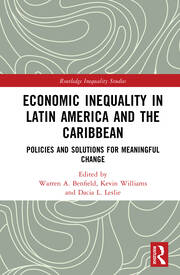
Economic Inequality in Latin America and the Caribbean Policies and Solutions for Meaningful Change
Foreword
Patrick Kent Watson
Introduction: The risks of inequality to economic growth in Latin America and the Caribbean
Warren A. Benfield, Kevin Williams and Dacia L. Leslie
PART I: Macroeconomic Factors and Public Policy
1. Economic Inequality in Latin America and the Caribbean (LAC): the risks to development
Warren A. Benfield, Ana Alas Iglesias and Richard Leach
2. Extractivism, Leftist Policies and Inequality: achievements, failures, and lessons of the Pink Tide in Brazil, Argentina, and Uruguay
Fabian Balardini
3. The Public Debt and Inequality Nexus: Evidence and lessons for Latin America and the Caribbean
Henry Mooney and Karelle Samuda
4. Critical Perspectives on Caribbean Poverty, Inequality, and Development
Dennis C. Canterbury and Randolph A. Williams
5. From margins to markets: Revisiting Arthur Lewis in the context of offender reintegration in Jamaica
Dacia L. Leslie
PART II: Specific Mechanisms and Sectoral Impacts
6. Globalisation and Income Inequality: Evaluating the Role of Governance Quality and Financial Development
Komla Amega
7. Remittances and inequality in Latin America and the Caribbean: An empirical exploration
Kevin Williams
8. Dollarisation and inequality in Central America and the Caribbean
Delisle Worrell
9. Trade, FDI and workers: Evidence from enterprise-level data in Costa Rica
Shruti Sharma
10. Unequal Structural Transformation Potential and the Sustainable Development Goals: Considerations for Small Island Developing States
David Tennant, Stuart Davies, Sandria Tennant and Patrice Whitely
PART III: Climate Justice
11. A New Generation of Have-Nots: An Exploration of Growing Inequality in the Face of a Changing Climate
Tanya Wragg-Morris and Leisa Perch
12. Strength in the Storm— Experiences of Indigenous Caribbean and Latin American Women Entrepreneurs Facing Climate Challenges
Rasheda Moody-Marshall
13. Integrating Conservation, Indigenous Rights, and Socio-Economic Change: Lessons from San Martín, Peru
Cindy Chávez Mendoza
Conclusion: Would policies without politics succeed?
Warren A. Benfield, Kevin Williams and Dacia L. Leslie
Biography
Warren A. Benfield is a Development Economist, an Honorary Research Fellow at the Sir Arthur Lewis Institute of Social and Economic Studies (SALISES) at the University of the West Indies (UWI) Mona Campus, and an Associate Professor of Economics at the Borough of Manhattan Community College, City University of New York (CUNY). He earned his PhD from the Institute of Development Studies at the University of Sussex, United Kingdom. Before joining BMCC, Professor Benfield worked at the Planning Institute of Jamaica, UWI, Hofstra University, Medgar Evers College, Kingsborough Community College, and LaGuardia Community College. He also worked in the Caribbean as a government adviser and consultant to several international development agencies, and in Tanzania at the World Bank Country Office's Economic Management Unit. His research focuses on public policy issues, including well-being measurement, social protection, poverty and inequality.
Kevin Williams is a Senior Research Fellow at the Sir Arthur Lewis Institute of Social and Economic Studies, The University of the West Indies. He is an Economist, who taught both graduate and undergraduate courses. He specialises in applied and development economics in developing countries.
Dacia L. Leslie is a Senior Research Fellow and Chair of the Crime Prevention and Offender Management Research Cluster hosted by the Sir Arthur Lewis Institute of Social and Economic Studies (SALISES), The University of the West Indies, Mona Campus. She is also a Commonwealth Scholar (United Kingdom) and a Fellow of the Max Planck Institute for the Study of Crime, Security and Law, Germany. Dr Leslie has researched and published widely in the last nine years on crime prevention and social justice, most notably on effective reintegration and correctional reform. Her non-commissioned research focuses on the lived experiences of inmates, ex-prisoners, removed migrants and their child dependents at the intersection of her teaching focus, which is on Development Studies, with a specialisation in Monitoring and Evaluation. Her peer-reviewed books include Recidivism in the Caribbean: Improving the Reintegration of Jamaican Ex-prisoners (2019).
"This is a timely and important book. It shows that inequality in Latin America and the Caribbean is the result of institutions, policy choices, and political structures that continue to shape opportunity and exclusion. The volume makes a compelling case that tackling inequality requires coherent public policy and sustained political will to tackle these constraints. It emphasizes climate change as a multiplier of injustice, especially in small island and highly vulnerable contexts, and underlines the disproportionate burdens borne by women, indigenous peoples, and marginalized communities. This book is essential reading for anyone interested in inclusive development, resilience, and social progress in the region."
Milasoa Chérel-Robson, PhD, Economist/Development Coordination Officer, UN Resident Coordinator’s Office (RCO), Haiti
"Few books capture the complexity of inequality in Latin America as clearly and courageously as this one. Challenging both faith in market solutions and the celebrated redistributive record of progressive governments, the authors reveal how extractivist development models, structural inequalities, and fragile institutions continue to reproduce injustice. The book ranges widely—from climate injustice and education gaps to misinformation, violent crime, and the policy failures exposed by economic and environmental shocks. By questioning conventional wisdom, including the limits of Kuznets-style thinking, it offers a powerful and timely analysis. This is essential reading for anyone seeking to understand—and seriously address—the region’s stubbornly persistent inequality."
Lizbeth Navas-Aleman, Global Value Chains specialist and Research Associate, Institute of Development Studies (IDS), Sussex University, UK
“Economic Inequality in Latin America and the Caribbean: Policies and Solutions for Meaningful Change pushes the envelope on the policy front, making the case for greater progressive public policy within the overarching framework of universal social protection, including active labour market interventions that address structural inequality and are responsive to economic and environmental risks. The book is a must-read for students and policymakers in the Global South."
Dillon Alleyne, Professor of Applied Economics, Director (interim) of the UWI-FRC, Honorary Research Fellow, SALISES, UWI Mona, Jamaica
"Economic Inequality in Latin America and the Caribbean: Policies and Solutions for Meaningful Change offers a timely and incisive examination of one of the region’s most persistent challenges. Bringing together leading scholars, the volume combines rigorous empirical analysis with thoughtful policy proposals addressing macroeconomic structures, sectoral dynamics, and climate justice. The book makes a compelling case for integrated social protection and inclusive development strategies, providing both analytical depth and practical insight for scholars, policymakers, and practitioners concerned with reducing inequality and advancing equitable growth in the region."
Sangeeta K Bishop, Ph.D., Professor of Economics, Borough of Manhattan Community College/CUNY, USA
