




1st Edition
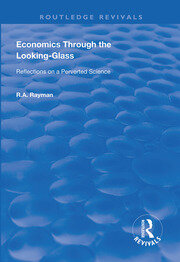
Economics Through the Looking-Glass Reflections on a Perverted Science
By R.A. Rayman
Copyright 1998
352 Pages
by
Routledge
352 Pages
by
Routledge
352 Pages
by
Routledge
Also available as eBook on:
Published in 1998. In spite of spectacular improvements in market flexibility, the characteristics of the past twenty years are slow growth and high unemployment. Economics Through the Looking-Glass exposes the theoretical fallacy at the heart of the New Economic Orthodoxy. The fallacy lies in treating the economy as a "single-gear" machine guaranteed to operate at its full employment potential... Read more
Part 1: The Dismal Science 1. The End of Economic Civilization as We Know It 2. The Breakdown of Law and Order 3. It Came from Outer Space 4. The Dismal Science Part 2: Religion and the Rise of Monetarism 5. The Revelation 6. The Classical Doctrine 7. The Immaculate Conception 8. The Golden Age of Classical Orthodoxy 9. The Keynesian Reformation 10. The Neo-Classical Counter-Reformation 11. Monetarism in Excelsis 12. The New Orthodoxy 13. The Single-Gear Economy 14. Reality and the Fall of Monetarism Part 3: A Young Person's Guide to Economic Theory 15. Tweedledum and Tweedledee 16. The Invisible Hand 17. Money Makes the World go Round 18. Saving: The Noblest Virtue 19. Saving: The Deadliest Sin 20. Money is the Root of All Evil 21. The Multi-Gear Economy Part 4: What’s Wrong with Economic Theory 22. What’s Wrong with Classical Economics? 23. What’s Wrong with Keynes’s General Theory? 24. What’s Wrong with Monetarism? 25. What's Wrong with the New Orthodoxy? Part 5: Economics Through The Looking Glass 26. What's Wrong with Religion? 27. The New Inquisition 28. The Revolution that Never Was 29. The Immaculate Misconception 30. The Myth of Say's Law 31. The Revelation that Never Was 32. The Lost Commandment: The Law of Circulation Part 6: Back to the Future 33. David Hume (1711-1776) 34. Anne Robert Jacques Turgot (1727-1781) 35. Francois Quesnat (1694-1774) 36. Richard Cantillon (1680?-1734) 37. Bernard Mandeville (1670-1733) 38. John Law (1671-1729) 39. John Locke (1632-1704) 40. Sir William Petty (1623-1687) 41. The Merchantilists.
Biography
R.A. Rayman
’...masterful and convincing...compulsory reading for all younger economists, most of whom have never had the benefit of studying the history of their discipline or a basis for questioning economic orthodoxy...a challenging and in many ways important book.’ The Business Economist
