




1st Edition
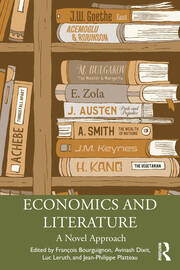
Economics and Literature A Novel Approach
Editors’ Introduction
Part I: Development and structural transformation of society and economy
1 A Bengali Novel on Economic Transition in History
Pranab Bardhan
2 Tradition and Modernity in sub-Saharan Africa: Insights from Achebe’s Things Fall Apart
Ernest Aryeetey and Jean-Philippe Platteau
3 The Art of Conquering Without Being Right: Agency, Education, and Learning by Doing in Cheikh Hamidou Kane’s Ambiguous Adventure
Paul-Aarons Ngomo, Shourya Sen, and Leonard Wantchekon
4 On Capitalism and Colonialism: The Economic Imperatives Underlying Amitav Ghosh’s Sea of Poppies
Mukesh Eswaran
5 The Lone Scream in the Dark: Cultural Change and Institutional Transformation in Modern China as seen through Lu Xun’s Novel
Debin Ma
6 Zola's "Ladies’ Paradise" and the "Creative Destruction"
François Bourguignon
7 Women in a nervous breakdown: Intra-household bargaining and gender norms in South Korea
Bishnupriya Gupta
Part II: Market operation and dysfunction
8 Only the Housing Problem Has Corrupted Them
Sergei Guriev
9 Can Machines Replace Us?
Dilip Mookherjee
10 Contract-enforcement institutions in Gurnah's By the Sea
Mustapha Kamel Nabli
11 Marriage and Markets: Lessons from Pride and Prejudice
Carmen Matutes
Part III: Limits of the Homo Economicus model
12 The Esterházy Myth: How Economics and Literature Correct Mistakes
Piroska Nagy-Mohacsi
13 Chekhov: The Nostalgia for Missed Opportunities
Jean-Philippe Platteau
14 The Financial Expert of Malgudi
Avinash Dixit
15 Estates, Inheritance and Gifts: Looking a Gift Horse in the Mouth
Luiz De Mello
16 The Inheritance Mess: Père Goriot and King Lear Offer Us a Mirror
Marianne David and Pierre Pestieau
17 The Master, the Helicopter, and Margarita
Luc Leruth and Danielle Meuwly
18 Money in the Faustian pact
Alfred Steinherr
Part IV: Rent-seeking, corruption and bad political governance
19 How Steinbeck Speaks to Institutions in Economics
Stuti Khemani
20 The Economics of Innocence: Imbolo Mbue’s “How Beautiful We Were”
Celestin Monga
21 Frank Herbert’s Dune
Mark Koyama
Biography
François Bourguignon is Professor Emeritus at the Paris School of Economics.
Avinash Dixit is Emeritus Professor of Economics at Princeton University.
Luc Leruth is Research Associate at the University of Clermont Auvergne.
Jean-Philippe Platteau is Emeritus Professor in the Department of Economics at the University of Namur.
I like happy endings -- so I was very pleased to learn about a literature student at a famous university who, being frustrated at not finding Steinbeck’s Grapes of Wrath in the literature section of the university library, could successfully locate it among books on agriculture. Boundaries between subjects can be overcome in different ways, including through confusion, but they can also be crossed deliberately in wise and enriching ways. This lovely book, with a fine collection of essays, has been led by an insightful and innovative plan of “bringing together” literature and economics. It is a splendid achievement. Rather than seeking a happy ending, we must wish for more works like this that bring together apparently distant disciplines.
- Amartya Sen, Lamont University Professor, Harvard University, and Nobel Laureate in Economics
Economists aim to understand human behavior and human interactions with the world. Novelists aim to illustrate how human interactions affect individuals’ emotions and behavior. In so doing both fields teach us about the world. Economics and Literature: A Novel Approach is a compilation of brilliant essays from a globally representative selection of economists who are also perceptive readers of fine literature. It entertains while illuminating the commonalities of economics and literature.
- Alison Booth, Emeritus Professor, Australian National University and author of novels including “Bellevue”, “A Perfect Marriage”, and “A Distant Land”
“Growing up on a university campus, with a love of reading and an economist father, I never thought there was a contradiction between literature and economics. Later, as a university student myself, I would discover that the two disciplines were placed in mutually separated silos — no economics was discussed in my literature classes, and no literature in my economics ones. This adventurous book seeks to remedy that deficiency, and to remind us that at the heart of intellectual fertility and creativity lies cross-pollination.”
- Mohsin Hamid (novelist, writer, winner of the LA Times Book Prize, author of Moth Smoke, and The Reluctant Fundamentalist)
“A good novel often teaches us more about the world than looking at facts and figures. And the same goes for economic theory which offers us a means of interpreting the world works that informs the way that we look at social and economic phenomena. This daring and entertaining collection of essays generates new insights, demonstrating that literature and economics have a lot in common.
- Tim Besley (School Professor of Economics and Political Science and W. Arthur Lewis Professor of Development Economics in the Department of Economics at LSE)
Economics and Literature: A Novel Approach will be a delight to anyone who is curious about the human condition. It is a great read for those who believe that economists’ way of thinking describes all human motivation; many good examples support your point of view. But it will also be a great read for those who believe that economic thinking misses the boat: such as misunderstanding the importance of true love. But, speaking of boats, this book with its selection of novels from many continents is a lot more fun than a round-the-world cruise. Its descriptions and critiques of those selected novels describe people in depth everywhere. And, if you do take that cruise, also do me, and yourself, a big favor. Please pack A Novel Approach in your baggage. Much better than any tour guide, it will explain what all those people around the world are really thinking; and why.
- George Akerlof (Daniel E. Koshland, Sr. Distinguished Professor Emeritus of Economics, University of California Berkeley; Nobel Laureate in Economics 2001)
