




1st Edition
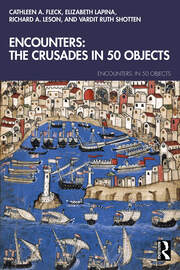
Encounters: The Crusades in 50 Objects
List of figures
Introduction
Part I. Belief
1. Cross
2. Yeshiva capital
3. Icon of St. Sergius and female donor
4. Qur’an of Nur al-Din
5. Painted fragment of an angel from Gethsemane
6. Reliquary of St. Marina
7. Altar from ‘Atlit Castle
8. Candlesticks from Church of the Nativity
9. Icon of the Nativity and Adoration of the Magi
10. Syriac lectionary
Part II. Conflict
11. Aleppo Codex
12. Slab with coats of arms over a Fatimid inscription
13. Cairo Genizah fragment
14. Jerusalem pilaster
15. Sword
16. D’Arenberg Basin
17. Game board
18. Gospels of T’oros Roslin
19. Templar Seal
20. Bell from Acre
Part III. Exchange
21. Imitation dinar
22. Sugar mold
23. Panel of a Holy Sepulcher reliquary
24. Buttons
25. Dagger with scabbard
26. Drinking cup
27. Albarello
28. Arsenal Old Testament
29. Windowpane fragment
30. Freer Canteen
Part IV. Power
31. Front cover of Psalter of Queen Melisende
32. Map of Jerusalem
33. Seal cast of Hospitaller master
34. Carved head of a knight
35. Denier from Amalric I
36. Miter of James of Vitry
37. Stone matrix
38. Jamb capital
39. Legal manuscript
40. Heraldic shield relief
Part V. Memory
41. Cadouin shroud
42. Pilgrim’s flask
43. Minbar of Nur al-Din/Saladin
44. Tomb of Baldwin V fragment
45. Seal matrix of Nahmanides
46. Pair of glass beakers
47. Histoire d’Outremer (History of Deeds done Beyond the Sea)
48. Epitaph stone of Isabel de Hana
49. Grandson Antependium
50. View of Acre from the Cocharelli Codex
Index
Biography
Cathleen A. Fleck is Professor of Art History and Director of the School of Visual Studies at the University of Missouri-Columbia. She has published articles and monographs on the court art of Naples and Avignon and on representations of Jerusalem in the crusader era of the Middle Ages (c. 1187–1356).
Elizabeth Lapina is Professor of Medieval History at the University of Wisconsin–Madison. Her main interest is in perceptions and representations—textual and visual—of the crusading movement in the twelfth and thirteenth centuries, on which she has published widely.
Richard A. Leson is Associate Professor of Art History at the University of Wisconsin–Milwaukee. His research and publications focus on the art and architectural patronage of elite French families, with a special emphasis on heraldry. He is currently writing about the life and artistic patronage of Jeanne of Flanders (ca. 1272–1333).
Vardit Ruth Shotten is an architect and archaeologist working in the Archaeological Research Department, Israel Antiquities Authority, whose research and writing focuses on medieval architecture, particularly in the Latin Kingdom of Jerusalem. She is currently leading the research project on ‘Atlit Castle and teaches at the University of Haifa.
“Through a rich, varied and stimulating collection of carefully chosen objects, this book offers a state-of-the-art and fascinating new way with which to engage with the crusading movement as an idea and with the polities established in the East following the Crusades. Ranging from objects attesting to daily life, commerce and cultural encounters, to objects attesting to aspects of warfare and conflict, the book presents a balanced, nuanced and vivid picture of life in the 'crusader states.' Eloquently written and beautifully illustrated, this captivating book will be of interest to both scholars and the general public alike.”
- Gil Fishhof, University of Haifa
“This is a marvelous volume that conveys the complexity of life in the eastern Mediterranean and the Kingdom of Jerusalem during the period of the crusades, ca. 1099–1291. The authors have chosen fifty objects spanning from buttons to drinking glasses, altars to swords, reliquaries to game boards that demonstrate the histories of conflict, but also shared practices of exchange, religiosity, power, and remembrance. Often beautifully written and enhanced by high-quality images the book offers a material history of encounters in the crusading world. Taken together it is an argument for the power of assembled fragments over a unified narrative. A model of collaborative scholarship the volume will be useful to anyone working on the crusader world and to all who teach this and related subjects.”
- Anne E. Lester, Johns Hopkins University
“An understanding of the past needs more than written sources. Readers of this volume see how archaeologists and art historians use objects, art and material culture to reveal the details of past societies, from the everyday to the elite. Each of the fifty objects described in this book becomes the focus of a deep dive into the Middle East of the crusader period, showing how Christians, Jews, and Muslims lived alongside each other in peace and war, sharing some aspects of their culture and also repurposing each other’s art and manufacture for new functions. Detailed explanations of each item provide both an accessible introduction for students and a scholarly resource for the more knowledgeable reader.”
- Helen Nicholson, Cardiff University
