




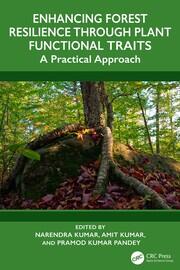
1st Edition
Enhancing Forest Resilience through Plant Functional Traits A Practical Approach
1. Introduction to the Concept of Plant Functional Traits
Himshikha Gusain and Jitendra Singh Butola
2. Plant Functional Traits in Forest Ecosystems and Their Ecological Importance: A Review
Meenakshi Sati
3. Anatomical Traits: Adaptations for Resource Acquisition and Allocation
Deepa Bisht, Upasna Sharma, and Narendra Kumar
4. Physiological Traits: Response to Environmental Stress and Resource Utilization
Pragya
5. Genetic Basis of Functional Traits Variation in Forest Tree Species
Jharna Maiti and Amit Joshi
6. Intraspecific Trait Variation and Tree Improvement Programme
Ram Gopal, Naresh Singh, Pankaj Lal, and Neha
7. Understanding Functional Trait Variation in Different Forest Ecosystems
Nada Tadi
8. Functional Trait Relationships with Tree Growth and Productivity
Divya Chaudhary, Anjali Joshi, and Arushi Arora
9. Significance of Plant Functional Traits in Soil Carbon and Nutrient Dynamics
Amit Kumar, Sarita Bisht, Narendra Kumar, and Rajesh Kaushal
10. Carbon Sequestration and Storage: Traits that Influence Forest Carbon Dynamics
Kalyani Supriya
11. Drought Tolerance and Water-Use Efficiency: Adapting to Climate Change
Tuhina Ghosh, Subrata Debnath, Aditya Pratap Singh, Victor Thingujam, Saptarshi Mondal, and Kousik Atta
12. Functional Traits as Indicators of Ecosystem Health and Biodiversity
Amit Joshi and Jharna Maiti
13. Conservation Efforts: Preserving Rare and Endangered Tree Functional Traits
Rowndel Khwairakpam, Rajneesh Bhardwaj, Charu Bisht, Bokado Kangujam, and Narendra Kumar
14. Enhancing Resilience: Harnessing Traits for Coping with Disturbances
Naresh Singh, R. S. Bali, Pankaj Kumar, and Priyanka Thakur
15. Technological Innovations in Functional Trait Research
Anand Kumar, Laxmidas Verma, and Anamika Yadav
16. Future Avenues: Advancing Research and Implementation of Functional Traits
Laxmidas Verma, Anand Kumar, and Anamika Yadav
17. Climate-Resilient Approaches for Sustainable Water Management Through Forest Resilience and Plant Functional Traits
Amit Bijlwan, Ankita Jha, Shivani Kothiyal, Roomesh Kumar Jena, and Rajeev Ranjan
18. Functional Traits for Predicting Climate-Driven Forest Changes
Kashish Walia, Yourmilla Kumari, Garima, and Aruna Mehta
Biography
Narendra Kumar obtained his Ph.D. in Plant Physiology from G.B Pant University of Agriculture and Technology, Pantnagar, India. His research focused on the response of plants to abiotic stresses. Later, he served as an Assistant Professor in various reputed academic institutes, especially Surajmal Aggarwal (Pvt.) Kanya Mahavidyalaya, Kichha, US Nagar, India; Dev Bhoomi Group of Institutions, Dehradun, India; and Uttaranchal University, Dehradun, India. He also worked as Research Associate at Forest Research Institute, Dehradun. His research interests primarily include plant physiology, ecophysiology, plant response to abiotic stresses, climate change adaptation and mitigation, functional traits, and climate change modeling. He has supervised many M.Sc. students, with many more currently under supervision. He has published various papers/chapters/articles in national and international peer-reviewed journals with high impact factors. He has edited many books with international publishers, and has served as an editor for many journals on current subjects. He is currently employed as Assistant Professor in the College of Agriculture at Central Agriculture University (Imphal), Kyrdemkulai, Meghalaya, India.
Amit Kumar is a distinguished researcher, a renowned author, and a leading expert in the fields of plant physiology, forestry, and climate change. Driven by an insatiable curiosity about the natural world and a deep-rooted passion for environmental conservation, he has dedicated his life to understanding the intricate relationships between plants, ecosystems, and the ever-changing climate. He earned his Ph.D. in Forestry from Forest Research Institute, Dehradun, India. His research is primarily focused on plant functional traits of forestry ecosystems. Earlier, he worked as an Assistant Professor in many organizations, i.e., Dolphin P.G. Institute of Biomedical and Natural Sciences, Dehradun, and Alpine Group of Institutes, Dehradun, Uttarakhand. He has published several research articles, books, and book chapters in peer-reviewed journals with high impact factors. He has edited many books with international publishers. He has received several awards from prestigious organizations, i.e. Young Scientist Award from UCOST Dehradun, Uttarakhand; Emerging Scientist Award from VDGOOD Foundation, Kolkata; and Best Research Paper Award from Indian Association of Soil and Water Conservationists, Dehradun. He has participated in more than 30 national and international conferences, symposia, and seminars. He has published more than 25 research papers in well-reputed national and international journals. Currently, he is working as Scientist in CSIR-Institute of Himalayan Bioresource Technology, Palampur, Himachal Pradesh.
Pramod Kumar Pandey is presently working as an Assistant Maize Breeder in All India Coordinated Research Project (AICRP) on Maize, Genetics and Plant Breeding, College of Agriculture, Central Agriculture University (Imphal), Kyrdemkulai, Meghalaya. He completed his postgraduate degree in Biotechnology at KIIT University, Bhubaneswar, Odisha. He obtained his Ph.D. in Biotechnology from Dibrugarh University, Dibrugarh, Assam. He has authored more than 50 scholarly research papers and articles and contributed to various book chapters. He has served as an editor for many journals on current subjects. He has supervised many M.Sc. and Ph.D. students, and many more are under supervision. He possesses around 10 years of academic and professional experience in his area of expertise.
