





1st Edition
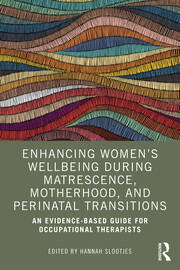
Enhancing Women’s Wellbeing During Matrescence, Motherhood, and Perinatal Transitions An Evidence-based Guide for Occupational Therapists
SECTION 1: Theoretical foundations for understanding the occupational nature of women’s health and matrescence
1. Redefining women's health in the 21st century: Embracing holistic perspectives and acknowledging gendered realities
Nerida Hyett, Kate McIntosh, Hannah Slootjes
2. Occupational therapy in women’s health: Gender-responsive practice approaches for girls and women throughout the lifespan
Nerida Hyett, Hannah Slootjes, and Kate McIntosh
3. Exploring feminist perspectives in women’s health, motherhood, and occupational therapy
Hannah Slootjes & Shinead Borkovic
4. Allied health and holistic care approaches to women’s health and wellbeing: A collaborative team perspective
Hannah Slootjes, Holly Andrews, Julia Jones, & Julie Fox
5. Enhancing women’s health through occupational therapy leadership
Shinead Borkovic and Hannah Slootjes
6. Breaking the silence on women’s invisible wellbeing challenges: Contemporary practice and research priorities
Hannah Slootjes, Samantha Tavender, Kylie McIntyre
SECTION 2: The occupational nature of matrescence
7. The occupational nature of matrescence
Hannah Slootjes and Annie DeRolf
8. Matrescence as a spiritual occupation and transformative life event: Rites of passage, rituals, and transitions
Hannah Slootjes, Annie DeRolf, and Märit Watson
9. Exploring the intersection of feminism, matrescence, and occupational therapy practice
Hannah Slootjes
10. The perinatal transitions of matrescence: An occupational therapy perspective
Hannah Slootjes
11. The occupational nature of women’s mental health and illness during perinatal transitions and matrescence
Mandy Graham
12. Power, agency, and fundamental human needs: Health, wellbeing, and quality of life during motherhood
Hannah Slootjes & Beth Ann Walker
SECTION 3: Occupational therapy skills and practice for perinatal health, motherhood, and matrescence
13. Foundations to facilitate knowledge translation for evidence-based best practice
Hannah Slootjes
14. Navigating ‘normal’ motherhood struggles: Movement, compassion, and occupational balance
Mara Cohen Podvey, Salma Bachelani, Megan Hatfield, Belinda McLean, Hollie Swanton, Miranda Little, Melissa La Pointe, Ellen O’Connor, Jessica Peterson, Gayle Schwee, Sharon Bergmann, MaryAnn Miller, Rachel Killorin Hemminger
15. Illuminating the dark side of matrescence: A practical guide for responsive occupational therapy practice
Rebecca (Bex) Twinley, Beth Ann Walker, Ellen Wainberg, Leah Austrian, Audrey Clavet, Shinead Borkovic, Melissa La Pointe, Carlin Daley Reaume, Sasha Wray
16. Addressing the occupational nature of menstruation: A human occupation approach
Freya McGregor, Janelle Gullan, Hannah Slootjes, Kylie McIntyre
17. Strengthening women’s psychosocial health, wellbeing, and quality of life during perinatal transitions and motherhood
Sarah Maris-Shaw, Mary Matthews, Beth Ann Walker, Gayle Schwee, Jessica Peterson, Sarah Ashton, Chelsea Atherton, Shameera Osman
18. Co-occupation-based interventions during perinatal transitions and motherhood
Maria Coxon, Amanda Mack, Kris Barnekow, Aviril (Apple) Sepulveda, Sarah Maris-Shaw, Audrey Clavet, Jessica Peterson, Nicole Amery, Miranda Little, Vanessa Bober, Gabriela Dias, Sharon Bergmann, MaryAnn Miller, and Rachel Killorin Hemminger
19. Occupation-based approaches to pelvic health and wellbeing
Pamela Hess, Christyna L. Kiesel, Carlin Daley Reaume, Janelle Gullan, Lara Desrosiers, Lindsey Vestal
20. Empowering mothers during recovery: Occupational-based strategies for women working through perinatal mental disorders
Leah Van Antwerp, Mary Matthews, Davina Jhammun, Marique Smolanaers, Laura Hucks
21. A neurodiversity-affirming approach to matrescence: Empowerment through person-centred and strengths-based occupational therapy practices
Rebecca (Bex) Twinley, Danielle Hitch, Ellen Wainberg, Rachel McFedries, and Hannah Slootjes
22. Empowered girls and women with low vision and blindness across the lifespan: Navigating gendered occupations during perinatal transitions of matrescence
Carlia Rix and Hannah Slootjes
23. Empowering connections: Storytelling, lifespan approaches, and therapeutic mother’s groups for enhanced wellbeing
Wendy Gaughan, Hannah Slootjes, Leora Rozin, Ellen O’Connor, Kiley Hanish, Natalie Miller, Tiana Andrews, Shinead Borkovic, Sarah Maris-Shaw
24. Navigating menopause transitions: Holistic occupational therapy approaches for enhancing women’s wellbeing
Sarah Hausler, Hannah Slootjes, and Bronwyn Paynter
Biography
Dr Hannah Slootjes is an Australian occupational therapist and academic (‘pracademic’), and Lecturer in Occupational Therapy at La Trobe University, with additional qualifications in literature, behavioural studies, and fine art. Dr Slootjes completed a PhD in 2022 exploring the occupational therapist’s role in perinatal health, and has a special interest in women’s and girls' health, perinatal transitions, matricentric feminism, motherhood, and matrescence.
"Advancing occupational science to a new level, Enhancing Women’s Wellbeing During Matrescence and Perinatal Transitions vividly demonstrates the promise to both science and practice of an evidence-based, occupation-based, and feminist perspective on the transition into motherhood. This comprehensive text draws on contemporary theory to detail compassionate occupational therapy practice that transcends the medicalization of birth to focus on the occupational nature and challenges of matrescence. It offers practice approaches addressing identity transformation, perinatal mental illness and psychosocial health, occupational balance and quality of life in motherhood, perinatal health disparities, co-occupation-based practice with the mother-child dyad, recovery from perinatal trauma, supporting women with disabilities during matrescence, group-based narrative approaches using therapeutic mothers’ groups, managing the occupations of menstruation and menopause, and healthcare teaming and leadership in service to women in the process of becoming mothers. A must read for occupational therapists and scientists, and anyone wanting to learn about co-occupations and matrescence."
Dr Doris Pierce, Occupational Therapist, Fellow of the American Occupational Therapy Association, USA
"This ambitious and impressive book resets the role and practice of occupational therapy in relation to women and girls health across the lifespan. Through a foregrounding of transitions in women’s lives, including matrescence, perinatal health and wellbeing, the collection presents a challenge to existing professional practices and boundaries. From international guidelines to theoretically informed, individual reflexive praxis, the chapters cumulatively invite the reader to reflect and develop strategies for delivering gender-responsive and culturally-sensitive care. A must read for those studying, teaching and delivering occupational therapy and those seeking a more expansive understanding of matrescence."
Professor Tina Miller, Oxford Brookes University, UK
"This groundbreaking book on women’s occupations, health, and well-being is an important addition to the literature for all allied health professions. It provides a comprehensive and theoretically grounded understanding of women’s health throughout the lifespan. It also offers the occupational therapy practitioner practical strategies for meeting the needs of their clients."
Dr Betsy Francis-Connolly, School of Health Sciences, University of New Haven, U.S.A
"A text book that enlightens and enriches the research and practice of occupational therapy to radically transform the discipline. The book perceptively exposes the silence, under-recognition, and dismissal of research on women's health and wellbeing and develops a gender-sensitive and culturally informed theory and praxis that moves us beyond traditional medical models and provides practical strategies and goals for inclusive and holistic healthcare to support and empower women throughout the life course. Particularly innovative, illuminating, and useful are its discussions on matrescence, mothering/motherhood occupations and matricentric feminism which deliver a long overdue and urgently needed mother-centred theory and practice for maternal health promotion. A foundational text in Occupational Therapy and Motherhood Studies."
Dr Andrea O’Reilly, York University, Canada; Founder of Motherhood Studies, Maternal Theory, and Matricentric Feminism
"How long have women and girls waited for a gender-responsive perspective in occupational therapy? A long time. As a female dominated profession, occupational therapy has struggled to assert the uniqueness of being female, the impacts of gender and the risks and consequences of being female. This wonderful book is evidence that the occupational therapy profession has evolved to acknowledge the unique health, wellbeing, economic, sociocultural factors and environmental situation of women and girls, and the reciprocal impacts on occupations. The chapters are scientific, sensitive and powerful—written by women, for women, to help women and girls. Authors present an array of issues for occupational therapy professionals: the health of women and girls; the marginalisation and oppression of women and girls and their health needs; the phases of menstruation, pregnancy and menopause; the changing roles and occupations of women and girls in modern society; and the female perspective with an occupational therapy lens. This brave book advances occupational therapy practice with women and girls, to move research and practice closer to a highly targeted, evidence-based specialisation which can only result in better provision of services for females across the lifespan. The authors are brave, because gender-based specialism can attract criticism. If it was easy to write a book like this, it would have been done already! The book validates gender-based differences, acknowledges vulnerabilities, oppression and injustice, and opens up future chapters about harnessing the power of women and girls. The occupational therapy profession must advocate to empower women and girls to experience better health and exercise their rights to participate in occupations of choice. As an occupational therapist who has specialised in the health, wellbeing and empowerment of mothers of children with disability, I’m so appreciative of this book. I encourage others to delve into the contents because women and girls are amazing!"
Professor Helen Bourke-Taylor, Monash University, Australia; Occupational Therapist and Creator of Healthy Mothers Healthy Families
