





1st Edition
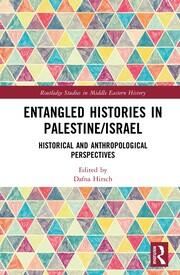
Entangled Histories in Palestine/Israel Historical and Anthropological Perspectives
1. Introduction: Entangled Histories through a Magnifying Glass
Dafna Hirsch
Section I: Jews and Arabs Pre-1948
2. The Violent Struggle over Land: The Beginning of the Zionist Armed Settlement Strategy, 1908-1914
Daniel DeMalach and Lev Luis Grinberg
3. "The Same Sea": Jews and Palestinians on the Beach in the Late Ottoman and Mandate Periods
Boaz Lev Tov
Section II: Practices and Memories of Displacement
4. Miracles and Snow in Palestine and Israel: Tantura, a History of 1948
Alon Confino
5. Coping with the Present Past: Personal Recollection among Palestinian Internally Displaced Persons
Rana Awaysi
Section III: Facing the Settler State
6. Accumulation and Surveillance: The Military Rule in Lydda, July 1948-July 1949
Benny Nuriely
7. The First Act in the Struggle of the Ma'barot, 1951-1952: Contestation amid Subjection
Gadi Algazi
8. When "Human Material" Says No: Noncompliance, Resistance and Protest among the Settlers of the Lakhish Project, 1954-1962
Smadar Sharon
Section IV: Labor and the Formation of National and Ethnic Hierarchies
9. Reconstructing the Labor Process: The Of-Ar Factory, 1961-1979
Shani Bar-On Maman
10. The Men Who Knew Too Much: Sardines, Skills and the Labor Process in Jaffa, Israel,1948-1979
Naor Ben-Yehoyada
Section V: Telling/Cleansing History
11. Palestine’s Absent Cities: Gender, Memoricide, and the Silencing of Urban Palestinian Memory
Manar Hasan
12. Discourse of Separation: Taboos and Depoliticization in Haifa’s Guided Tours
Regev Nathansohn
13. Silenced in History? Naqab Bedouin Women and their Narratives of the Past
Safa Aburabia
14. Afterword
Dafna Hirsch
Biography
Dafna Hirsch is a Senior Lecturer at the Department of Sociology, Political Science and Communication, The Open University of Israel. She has published many articles and is the author of the book "We Are Here to Bring the West": Hygiene Education and Culture Building in the Jewish Society of Mandate Palestine (2014, Hebrew). Her work focuses on food consumption, the body, and gender in Zionist history.
"Through close examinations of mundane moments of leisure and work, oppression and resistance, silencing and resistance, this volume carves out a space between history and anthropology. It is a fascinating collection of empirical studies that makes an excellent contribution to shaping the emerging field of integrated and relational Palestine/Israel Studies."
Tamir Sorek, Liberal Arts Professor of Middle East History, Penn State University, United States
"Entangled Histories in Palestine/Israel: Historical and Anthropological Perspectives is a truly original collection of critical research exploring historical, political and social events, and places and moments in Palestine/Israel. The book presents a diversity of academic disciplines as well as rich theoretical discussion and empirical evidence. This book is a foundational, and most updated, critical study on Palestine/Israel, and will certainly be a key source of knowledge."
Haim Yacobi, Professor of Development Planning, The Bartlett Development Planning Unit, UCL, United Kingdom
"In integrating Arab and Jewish narrative perspectives this book provides a long overdue treatment of national and ethnic splits in Palestine/Israel in novel ways. It approaches the history of Palestine and Israel from a critical perspective, mixing anthropological and from-below-historical aspects largely marginalized from the historiography of the region. In bringing forth the experiences, perceptions and memories of ordinary people in national conflict, and emphasizing the role of gender in the creation of a common Arab-Jewish perspective on the quotidian experience of politics, the book widens the notion of the political."
David De Vries, Department of Labor Studies, Tel Aviv University, Israel
