




1st Edition
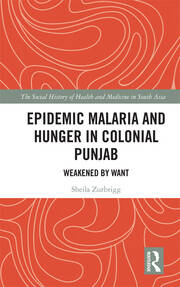
Epidemic Malaria and Hunger in Colonial Punjab Weakened by Want
1. Introduction PART I. Epidemic Malaria in Punjab: The Rain-‘Scarcity’ Model 2. Malaria in the Punjab (1911) 3. Theoretical and Methodological Issues 4. Testing the Rain-Price Epidemic Model 5. Outliers to the Rain-Price Epidemic Model 6. Mechanisms of ‘Intense’ Malaria PART II. Colonial Malaria Control: Policy and Practice 7. Pre-1909 Malaria Policy 8. The ‘Human Factor’ Articulated 9. Post-Simla: Malaria Control in Practice PART III. Shifts in Food Security, 1868-1947 10. Relief of ‘Established’ Famine: 1880-1900 11. The Shift to Famine Prevention 12. Acute Hunger and Malaria Lethality: ‘Test’ Cases Post-1940 13. Conclusion. Appendix. Bibliography
Biography
Sheila Zurbrigg is a physician and independent scholar based in Toronto, Canada. Her health history research investigates rising life expectancy in South Asian history in relation to food security. She has served as Short-Term Epidemiologist for the World Health Organization, Smallpox Eradication Program, Uttar Pradesh and Coordinator, Village Health Worker Program, Madurai, Tamil Nadu, India. She has also held appointments as Adjunct Professor, International Development Studies, Dalhousie University, Halifax, Nova Scotia, Canada; Visiting Scholar, York University, Toronto, Canada; and Visiting Scholar, Jawaharlal Nehru University, New Delhi, India. Her work with traditional village midwives in rural Tamil Nadu (1975–79) led to the analysis of child survival in contemporary India in relation to food security and conditions of women’s work. In 1985, she turned to South Asian health history research, funded by the Social Sciences and Humanities Research Council (Ottawa), and is currently investigating the epistemic shifts leading to loss of understanding of the role of acute hunger in the region’s malaria mortality history. Among her forthcoming work is her second monograph Uncoupling Disease and Destitution: The Case of South Asian Malaria History.
