




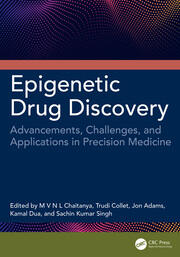
1st Edition
Epigenetic Drug Discovery Advancements, Challenges, and Applications in Precision Medicine
Table of Contents
Chapter 1: Introduction to epigenetics, its challenges, and future prospects
Kanaka Raju A, Vijay Srinivas P, Rushikesh B Katkar, Gana Manjusha Kondepudi
Chapter 2. Basic fundamentals in epigenetic diseases and their mechanisms
Aman Khandelwal, Suguna Kotte, S. Ponnusankar*
Chapter 3. Epigenetic drug discovery and its importance in precision medicine
Mohammad Aleemuddin, Ayesha Sultana*
Chapter 4. Traditional medicine and its importance in epigenetic healing
Venkateswara Rao Amara, Ajay Sharma, Abhishek Tiwari, Varsha Tiwari, Vineet Mittal, Mohan Gandhi Bonthu, Bhanu Sirisha Kagitapalli, Arya Lakshmi Marisetti
Chapter 5. Epigenetic Drug Discovery in multiresistant cancers and autoimmune diseases
Stuti Biswal, Rajeev Kumar Sahoo, Sambit Kumar Patra, Shikshya Swarupa Panda, and Bijesh Kumar Biswal
Chapter 6. Epigenetic drug discovery in inflammatory diseases
Silpa R. S, Akey Krishna Swaroop, Esakkimuthukumar M, Saranya R, Prabha T, Suresh S, Jubie S.
Chapter 7. Epigenetic drug discovery in neurodegenerative diseases
Madhavi Patel, Priya Shah, MVNL Chaitanya
Chapter 8. Importance of in silico tools and molecular docking knowledge in epigenetic drug discovery
Prabha Thangavelu, Pradeep Kumar MR, Jawahar Natarajan, Veerasamy Ravichandran, Muthu Kumaradoss Kathiravan
Chapter 9. Role of Indian traditional knowledge in epigenetic drug discovery
Rajan Logesh, Maruveettill Arjun, Saladula Hima, Prabitha Prabhakaran, Kumarappan Chidambaram
Chapter 10. Importance of OMICS in epigenetic drug discovery
Kella Alekhya, Anuciya R , Jawahar Rohith R , Kaviyarasan D
Chapter 11. Role of gut microbiota in epigenetic healing and their mechanisms
Arshia Razdan, Romi Shrestha, Lalitha Chaitanya, Smriti Arora
Chapter 12. Effect of Prebiotics And Probiotics In Epigenetics Healing And Their Therapeutic Molecular Evidences
Saranya Punniyakotti, N. Krishna Prabha, Nithya Varadarajan
Chapter 13. Epigenetic drug discovery and development from various marine sources
Rashmi Saxena Pal, Yogendra Pal,Shubham Kumar, Vedika Sharma, Nisha Kumari, Satya Kumar Avula
Chapter 14. Recent advancements in epigenetic novel drug delivery systems mapping with artificial intelligence
Gana Manjusha K, Chiranjeevi P, Aruna Kumari D
Chapter 15. Recent Developments in Epigenetics-Based Personalized Medicine
Deepti Katiyar, Shreya Dixit, Rajnandani Singh, Rashmi Saxena Pal, Pradeep Singh
Biography
Dr M V N L Chaitanya, BPharm, M Pharm (Phytopharmacy and Phytomedicine), PhD (Pharmacognosy); Educationist and Researcher was born on November 10, 1982, in Rajahmundry (A.P.), India. He has 14 years of experience in industry, academia, and herbal research. He is currently working as a professor in the School of Pharmaceutical Sciences at the Lovely Professional University, Phagwara, Punjab, India. Dr Chaitanya is a well-recognized conceptualist in herbal medicine, anticancer drug discovery and development, crystal healing, and psychic reading at the Indian and African levels. He has a keen ability in laboratory drug discovery and development from herbs, weeds, algae, and mushrooms, with a proven ability in quality documentation. An awardee of various awards such as the INSA Visiting Scientist award for 2019, the AIMF award for 2019, the NFPS best professor award for 2022, and the DK International Best Researcher award for 2023. He is a life member of the Association of Pharmaceutical Teachers of India, the Indian Pharmaceutical Association, the Institute of Scholars (Insc), and the International Natural Product Sciences Task Force. He had visited three African countries as part of academic research to explore the phytochemicals in Indo-African plants against resistant diseases such as cancer, malaria, and tuberculosis. Dr Chaitanya's extensive body of work includes numerous research papers, peer-reviewed articles, books, and book chapters, and he holds multiple patents for his innovations.
Dr Trudi Collet, a biochemist, was awarded her PhD from the Queensland University of Technology in 2007. She worked as a postdoctoral fellow at the Queensland Institute of Medical Research and investigated novel serological markers for the differential diagnosis of inflammatory bowel disease. Since 2009, she has returned to QUT and is now the leader of the Innovative Medicines Group (IMG), which is based at the Kelvin Grove campus of the Queensland University of Technology. The IMG conducts research on the medicinal properties of Australian native plants. Using plant-derived bioactive compounds and extracts, the IMG evaluates the biological potential including bactericidal effects, the deadly ESKAPE pathogens; viricidal effects against members of the Flaviviridae family (Dengue, Zika and West Nile viruses); wound healing properties; antimicrobial effects against sexually transmitted diseases and novel pharmacotherapeutic targets for common neurological disorders.
Prof Jon Adams is Distinguished Professor of Public Health, Director of the Australian Research Centre in Complementary and Integrative Medicine (ARCCIM) and Deputy Head of School (Research) at the School of Public Health, UTS. Professor Adams was recently awarded a prestigious Fulbright Senior Scholarship (Fulbright Commission, 2019-2020). Professor Adams is the world-leading public health and health services researcher focused upon self-care, informal health care and traditional, complementary, integrative and indigenous medicine use and practice. Professor Adams' research program has attracted over $20.7M in competitive external funding to date including 23 Category 1 Grants (with 17 NHMRC and ARC grants). His extensive research program, conducted with many industry partners (>$10M in partnership funding), includes focus upon practice-based research networks (PBRNs), implementation science and translation research and mixed methods design. Professor Adams has authored over 560 peer-reviewed academic publications and is Chief Editor of eight international research books and author of over 70 book chapters with leading publishers.
Dr Kamal Dua is Associate Professor in the Discipline of Pharmacy at the University of Technology Sydney (UTS). Dr. Dua has been recognized and named one of Australia’s Top 250 researchers in 2025 and 2024 in Research Magazine by "The Australian" in the research discipline of health and medical sciences and no. 1 research leader in the area of pharmacology and pharmacy (2025) and toxicology (2024), respectively. With over 17 years of research experience, he has specialized in drug delivery targeting inflammatory diseases. Additionally, he also leads drug delivery research at the Woolcock Institute of Medical Research. In this role, he focuses on advancing targets identified in research projects to develop innovative formulations, taking the first steps toward clinical translation. His research encompasses two complementary areas: drug delivery and immunology. His work explores how these disciplines can mutually benefit, contributing to the goal of promoting longer and healthier lives for the community. His commitment to synergy is reflected in his extensive publication record in reputable journals. His research interests are centered on harnessing the pharmaceutical potential of modulating critical regulators, such as interleukins and microRNAs. He also specializes in developing new and effective drug delivery formulations for managing inflammation in chronic airway diseases and cancer.
Dr Sachin Kumar Singh, a Professor at the School of Pharmaceutical Sciences, Lovely Professional University, India, earned his Master of Pharmacy in Pharmaceutical Analysis from J.S.S. College of Pharmacy, Ooty, Tamil Nadu, India and earned his PhD in Pharmaceutical Sciences from Karpagam University, Coimbatore, India. He has completed one DST-SERB funded project on development of SNEDDS of Polypeptide-k for treatment of diabetes mellitus. Dr. Singh has published more than 200 research papers with cumulative impact of 400 and co-authored 10 book chapters. He has two granted Indian patents and two granted Australian patents. In January 2020, he received Dr. B.C. Deb memorial award for popularization of science by Indian Science Congress Association at 107th Indian Science Congress held at UAS Bengaluru. He is the first recipient from the field of Pharmaceutical Sciences to receive this award. He is also a recipient of 2014 Bharat Shiksha Ratan Award given by Global Society for Health and Educational Growth, Delhi, India. His core area is improving oral bioavailability of drugs exhibiting poor water solubility characteristics using various formulation approaches including nanotechnology, complexation, solid dispersion, and liquisolid technology.
