




1st Edition
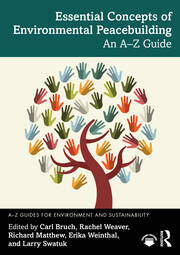
Essential Concepts of Environmental Peacebuilding An A–Z Guide
Introduction: Fostering Dialogue of Environmental Peacebuilding: Toward a Shared Understanding
Rachel Weaver, Richard Matthew, Erika Weinthal, Larry Swatuk, and Carl Bruch
Introduction
Context
Methodology
Moving the Field Forward
Conclusion
30✕30
A
Accountability
Adaptation
Adaptive Management
Agriculture
Agricultural-Pastoral Conflict
Anthropocene
B
Backdraft
Basic Services
Basin at Risk
Benchmarking
Biodiversity
Blame Avoidance
Boomerang Effect
C
Capacity Development
Cities
Citizen Science
Climate Change
Climate Diplomacy
Climate Migrant
Climate-Related Security Risks
Climate Security
Co-benefits
Confidence-Building Measures
Conflict
Conflict Environmental Assessments
Conflict Life Cycle
Conflict Prevention
Conflict Resources
Conflict Sensitivity
Conflict Transformation
Conservation
Cooperation
Critical Minerals
D
Decolonization
Depoliticization
Diagnostic Framework
Digital Technologies
Disaster Diplomacy
Disaster Risk Reduction
Displacement
E
Earth Observation
Ecocide
Ecological Distribution Conflicts
Ecological Peace
Ecosystem Services
Ecoterrorism
Ecotheology
Energy Security
Environment
Environmental Change
Environmental Cooperation
Environmental Crimes
Environmental Defender
Environmental Degradation
Environmental Justice
Environmental Migration
Environmental Peacebuilding
Environmental Peacemaking
Environmental Security
Environmental Terrorism
Environmental Violence
Empowerment
Evaluation
Extractive Resources
F
Faith-Based Environmental Peacebuilding
Farmer-Managed Natural Regeneration
Food Security
Fossil Fuels
Forests
Fragility
G
Gender
Gender-Based Violence
Gender Equality and Social Inclusion
Gender-Just Transition
Governance
H
Human Rights
Human Right to a Clean Environment
Human Right to Water
Human Security
Human–Wildlife Conflict
Hydro-Hegemony
I
Indicator
Indigenous Knowledge
Indigenous Rights
Infrastructure
Integrated Water Resources Management
International Humanitarian Law
J
Justice
Just Transition
L
Land Degradation
Land Grabbing
Land Tenure
Land Use
Learning
Legal Pluralism
M
Maladaptation
Mediation
Militarism
Mitigation
Monitoring
N
Natural Resources
Natural Resource Conflict
Nature-Based Solutions
Negative Peace
P
Participation
Participatory Process
Pastoralism/Transhumance
Peace
Peace Agreements
Peacebuilding
Peace Dividend
Peace Parks
Political Ecology
Polycrisis
Positive Peace
Power
Protected Zones
Protection of the Environment in Relation to Armed Conflicts
R
REDD+
Remote Sensing
Renewable Energy
Reparations
Resilience
Resource Curse
Restorative Justice
Reverberating Effects
Rights of Nature
S
Securitization
Security
Silvopastoralism
Social Cohesion
Stakeholder
Sustainability
Sustainable Development
Sustainable Peace
Systems Approach
T
Theory of Change
Threat Multiplier
Toxic Remnants of War
Transboundary Cooperation
Transdisciplinarity
Triple Bottom Line
Triple Nexus
V
Violence
W
War
Water Cooperation
Water Diplomacy
Water-Energy-Food Nexus
Water Security
Weaponization of Natural Resources
Y
Youth
Annex I: Institutions in Environmental Peacebuilding
adelphi
African Union (AU)
Alliance for Peacebuilding (AfP)
Alliance of Bioversity and the International Center for Tropical Agriculture (CIAT)
Antarctic Treaty
The Center for Climate and Security (CCS)
The Climate Security Mechanism (CSM)
The Conflict and Environment Observatory (CEOBS)
Conservation International (CI)
Convention on Biological Diversity (CBD)
EcoPeace Middle East
Energy Peace Partners (EPP)
Environmental Change and Security Program, Wilson Center
Environmental Law Institute (ELI)
Environmental Peacebuilding Association (EnPAx)
The Fund for Peace (FFP)
Reference
Global Environment Facility (GEF)
Green Climate Fund (GCF)
Intergovernmental Panel on Climate Change (IPCC)
International Court of Justice (ICJ)
International Institute for Sustainable Development (IISD)
International Law Commission (ILC)
International Military Council on Climate and Security (IMCCS)
International Union for Conservation of Nature (IUCN)
Nile Basin Initiative (NBI)
PAX
South Asian Association for Regional Cooperation (SAARC)
United Nations Convention on the Law of Non-Navigational Uses of International Watercourses
United Nations Convention to Combat Desertification (UNCCD)
United Nations Department of Peace Operations (UNDPO)
United Nations Environment Programme (UNEP)
United Nations Framework Convention on Climate Change (UNFCCC)
United Nations Security Council (UNSC)
The Women in Water Diplomacy Network (WWDN)
World Bank Group (WBG)
Biography
Carl Bruch is Director of International Programs at the Environmental Law Institute (ELI) and Executive Director of the Environmental Peacebuilding Association (EnPAx), USA. His research focuses on environmental law, policy, and practice in conflict-affected situations.
Rachel Weaver holds a Master of Environmental Management from Duke University, USA, with concentrations in Environmental Economics and Policy, and Terrestrial and Freshwater Ecosystems. At Duke, she served as a Graduate Research Assistant and as a Member of the Conference Secretariat for the Environmental Peacebuilding Association.
Richard Matthew is Professor of Urban Planning and Public Policy at the University of California, Irvine, USA. He is Director of UCI’s Climate and Urban Sustainability Program and the Alec Glasser Center for the Power of Music and Social Change. His research focuses on the connections among climate change, conflict, health, and displacement in highly vulnerable regions.
Erika Weinthal is John O. Blackburn Distinguished Professor of Environmental Policy, a Member of the Bass Society of Fellows at Duke University, and the President of the Environmental Peacebuilding Association, USA. She specializes in global environmental politics and environmental security with an emphasis on water and energy.
Larry Swatuk is Emeritus Professor in the School of Environment, Enterprise and Development (SEED) at the University of Waterloo, Canada. He is also Extraordinary Professor in the Institute for Water Studies, University of the Western Cape, South Africa; External Researcher, Bonn International Centre for Conflict Studies, Germany; and Vice-President of the Environmental Peacebuilding Association.
