




1st Edition
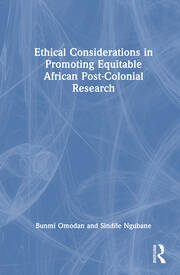
Ethical Considerations in Promoting Equitable African Post-Colonial Research
Preface, 1.Introduction to Ethics in Post-Colonial Research 2. Navigating Power Dynamics and Inequality 3. Informed Consent in Diverse Cultural Contexts 4. Community Engagement and Co-Creation of Knowledge 5. Ethical Considerations in Data Collection and Management 6. Publication Ethics and the Dissemination of Findings 7. Future Directions and Emerging Ethical Considerations, Bibliography, Index
Biography
Bunmi Isaiah Omodan is a scholar and National Research Foundation (NRF)-rated researcher, research methodology expert, and decolonial scholar whose work focuses on ethics, power, and equity in post-colonial and community-based research contexts. His scholarship critically engages with transformative, participatory, and decolonial inquiry, with particular attention to African and community research environments. He has two PhDs, one in Education Management and Leadership, the other in Governance and Political Transformation, with an extensive publication record, including over 130 peer-reviewed publications, such as journal articles, conference proceedings, and book chapters, as well as four scholarly books. Some of his books include Participatory Action Research in Post-Colonial Contexts (Routledge, 2025) and Research Paradigms and Their Methodological Alignment in Social Sciences (Routledge, 2024), both of which are widely used in postgraduate research training and methodology courses. His work appears in leading international journals and contributes to debates on research ethics, decolonial methodologies, supervision, and knowledge governance. Bunmi Isaiah Omodan is editor-in-chief of three interdisciplinary journals and serves on multiple international editorial boards. Beyond publishing, he regularly delivers research lectures, postgraduate workshops, research ethics training, and invited talks on decolonial methodologies, reflexive research practice, and scholarly writing. Through these networks, his work reaches academics, doctoral researchers, ethics committees, and community-engaged practitioners across Africa and beyond.
Sindile Amina Ngubane is an inclusion scholar, a National Research Foundation (NRF) C2-rated researcher, engaged in research, community engagement, and mentorship on digital access for students and employees with disabilities, incarcerated students, and women in open and distance learning contexts. She is also the head of the Institute for Open and Distance Learning at UNISA, Programme Director at the African Council for Distance Education, and former president of the Distance Education Associations in Southern Africa. She is also the former deputy president of the UNISA Women’s Forum, deputy director at the Advocacy and Resource Centre for Students with Disabilities, and the curriculum transformation specialist in the Curriculum Transformation Unit, focusing on transforming curriculum design and delivery for inclusion. She has published extensively, including a book on Cases on Universal Access to Education through Open and Distance e-Learning. She has supervised and co-supervised postgraduate students, with a special effort to increase PhD holders from marginalised communities, as part of the National Development Plan 2030 to expand the number of PhD holders in South Africa. In addition, Prof Ngubane leads cross-border collaborative research and community engagement projects aiming to create digitally inclusive approaches for the sustainable development of vulnerable communities
