




1st Edition
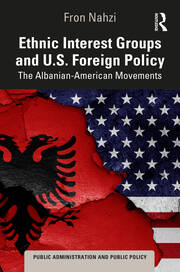
Ethnic Interest Groups and U.S. Foreign Policy The Albanian-American Movements
Introduction
Part One: Brief History of the Albanians
Part Two: The First Wave. National Self-identification and the Founding of the Albanian State
Part Three: Second Wave. Anti-Communism Movement: Political Exiles and Political Refugees
Part Four: Third Wave. Kosovo’s Self-determination Movements
Part Five: Epilogue
Biography
Fron Nahzi is one of the leading experts on the Western Balkans and on the Albanian-American Community. In the late 1980s and early 1990s, he played a pivotal role in mobilizing Albanian-American organizations in support of Kosovo and Albania’s democratic movements. Since 1991, he has led numerous democratic development programs across the Western Balkans, Eastern Europe, and Southeast Asia. His work has been supported by major institutions, including the British Council, European Commission, Rockefeller Brothers Fund, Open Society Foundations, Ford Foundation, and the governments of Sweden, Canada, the Netherlands, and the United States. During the Yugoslav wars, Nahzi was the senior editor of the award-winning Institute for War and Peace Reporting. He has served as a guest analyst for CNN, BBC, PBS, and NPR, and his commentary has appeared in leading international outlets such as The Guardian, The Independent, Le Courrier, Politico, The Hill, European Voice, Project Syndicate, Newsday, and Huffington Post. He is also a regular contributor to BalkanInsight. Nahzi has presented on international development and Balkan affairs at forums organized by the United Nations, OSCE, EU, the Austrian and Dutch foreign ministries, and universities including Columbia, Georgetown, Tufts, the New School, Albany, and Fundação Getulio Vargas (Brazil). He is currently an Adjunct Faculty Instructor at American University’s School of Public Affairs, USA.
“The most serious and comprehensive study to date of the Albanian-American community: how its members arrived, how they organized themselves, and how they tried to shape US policy toward Albania, Kosovo, and the wider region.”
Fred Abrahams covered Albania, Kosovo and Macedonia for Human Rights Watch from 1993 to 2000 and authored the book Modern Albania: From Dictatorship to Democracy (NYU Press).
“Nahzi writes from the inside about a story that his family lived. This personal dimension gives the book a weight that is rarely achieved by purely academic studies of the diaspora. Nahzi recounts and analyzes this story, drawing not only on memory, but also on declassified CIA files, State Department cables, US Congressional documents, and interviews with key actors. The result is a history of more than a century of efforts by Albanian-Americans to influence American policy toward Albania and Kosovo, from the first wave of Albanian immigrants who went to Boston in the early 20th century to the activists and lobbyists who helped push NATO toward intervention in Kosovo in 1999.”
Ledio Cakaj is a former American diplomat and author of When the Walking Defeats You, a narrative about the Lord's Resistance Army in Central Africa (Zed, 2016).
