




1st Edition
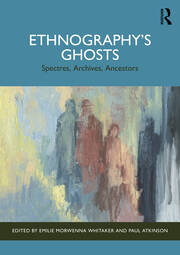
Ethnography’s Ghosts Spectres, Archives, Ancestors
Notes on contributors
Preface and Acknowledgements
- Introduction: Ghosts, Ancestors and Ethnography
Emilie Morwenna Whitaker and Paul Atkinson - Ghosts and the Archive
Emilie Morwenna Whitaker - An Anthropologist among Ghosts: On a House, Images, and the Many Uses of Ethnography
Paolo Favero - A Haunted Field: The Ghosts of Abuse in Spiritual Communities
Cristina Rocha - The Ghosts of First Fieldwork
Deborah Reed-Danahay - When I Was a Theatre Ghost: Spectral Stories and Forms of Folklore in the Field
Helena Wulff - Agnosticism and Spectrality: Ghostly Traces and Ethnographic Experience
Michael Herzfeld - Perceiving the Beyond of ‘End-of-Life’: The Idea of Commuting Ghosts
Tia DeNora - Return to the Orixás
Roger Sansi - What Kind of an Ancestor Do You Want to Be? Engaging with Tūpuna in Indigenous Ethnography in Aotearoa New Zealand
Maia Hetaraka, Selena Meiklejohn-Whiu, Justice Hetaraka, Katie Fitzpatrick, and Melinda Webber - The Ghosts Behind My Chair: Reflections on the Fieldwork at St. Luke’s
Sara Delamont - Spectral Goffman
Greg Smith - Out of Step – Out of Time: Haunted by the Loss of the World
Black Hawk Hancock - An Ethnographic Sojourner
Paul Atkinson
Index
Biography
Emilie Morwenna Whitaker is a Senior Lecturer in Social Sciences at the University of Salford, where she is also Director for Postgraduate Research. She has undertaken and led ethnographic fieldwork in health, social work, and welfare settings.
Paul Atkinson is Emeritus Professor of Sociology at Cardiff University, where he served as Pro Vice-Chancellor. His recent publications include the last two books in his Ethnography quartet, Writing Ethnographically (2020) and Crafting Ethnography (2022). He is a Fellow of the Academy of Social Sciences and of the Learned Society of Wales.
'As every ethnographer recognises, fieldwork looks back as it looks forward. This elegant collection with contributions by leading scholars makes the point clearly and powerfully. Ghost inhabit our research as they should as we are inspired or troubled by past studies. Ethnography’s Ghosts is a creative push to engage beyoind the present and to walk arm in arm with our ghostly ancestors.'
Gary Alan Fine, Northwestern University and Emory University, USA.
'Returning to one’s field notebooks allows the past observed, the present of observation, and the anticipated future to be reanimated, creating a reflective temporal tension. The authors offer lucid and original reflections on the role of memory, personal archives, and intellectual ancestors in shaping ethnographic knowledge. These essays illuminate the temporal and reflexive dimensions of fieldwork, capturing how emotion lies at the very heart of ethnographic inquiry.'
Silvia Cataldi, Sapienza University of Rome, Italy.
'The forward momentum created by ever stronger pressures to publish mean that we rarely pause to take stock of our creations, let alone the shoulders on which we (often precariously) stand. Beyond wonderful insight into the production of ethnographies, this elegant collection of essays is a prompt for us to do likewise: to revisit the ‘ghosts’ of Christmas past – the flotsam and happy accidents, self-destructive choices and occasional moments of clarity – that continue to shape us, and our writing, today.'
Mark de Rond, Cambridge University, UK.
'This imaginative collection explores ethnographers’ processes of re-engagementwith their own research. Through relational acts of remembering, reviewing, reviving and reflecting, we dynamically encounterour ghostly source materials from archival fieldnotes to influential ancestors and past versions of ourselves. Refreshingly creative, the book makes a valuable contribution to qualitative research methodology.'
Susie Scott, University of Sussex, UK.
