




1st Edition
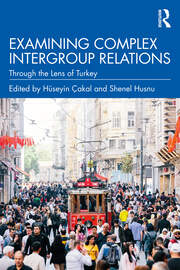
Examining Complex Intergroup Relations Through the Lens of Turkey
List of Contributors
Acknowledgments
Preface – Editor’s Introduction
Part I: Intergroup Relations: The Traditional Minorities
1 Fathoming Forgiveness: Armenians and Turks in Turkey
Demet İslambay Yapalı, Banu Cingöz-Ulu
2 Perceptions of Discrimination and Social Contact among Alevis and Sunnis in Turkey: Findings from Two Field Studies
Gülçin Akbaş, Elçin Ray-Yol, & Nebi Sümer
3 Disability and Discrimination: Disability Microaggressions in Turkey
Deniz Canel Çınarbaş, Deniz Albayrak Kaymak, & Hande Sart
4 How Does Culture Relate to Benevolent and Hostile Sexism? Fatih Özdemir & Nuray Sakallı
5 Young People’s Attitudes toward Old People: Prejudices, Stereotypes, Inter-group Evaluations, and Frequency of Contact
Nagihan Taşdemir
6 Missing the good old days or connecting to the globe: Investigating outgroup attitudes through collective nostalgia and global identification
Yasin Koc, Bengisu Akkurt, Ayca Aksu, Zeynep Dogan, Denizhan Sengul, Joel Anderson
Part II: Intergroup Relations: The New Minorities
7 Acculturation and Adaptation of Syrian Refugees in Turkey: The role of (dis)concordance of acculturation orientations and identity threat
İmge Terzi, Rita Guerra, Kinga Bierwiaczonek
8 Acceptance of Syrian refugees in Turkey: The roles of perceived threat, intergroup contact, perceived similarity, and temporary settlement
Şenay Yitmen, Maykel Verkuyten, Borja Martinovic, Murat Erdoğan
9 Identities and Attitudes Toward Syrian Refugees in Turkey
Meltem Güler, Halime Ünver, Hüseyin Çakal
10 "Syrian" refuge at the gaze of Kurds and Arabs in Mardin: Understanding social representations and acculturation expectations from a decolonial approach
Meral Gezici Yalçın, Canan Coşkan, Mine Batu, Ömer Kan, Nihan Yılmaz
11 Extended Contact with Turks and Syrian Refugees’ Intention to Migrate: The Mediating Roles of Ingroup and Outgroup Identification by Zafer Özkan and Naif Ergün
12 Intergroup contact among majority and minority status groups in Turkey: Extending theory and practice
Sabahat Cigdem Bagci, Sofia Stathi, Berfin Acar
Part III: Intergroup Relations and Political Culture
13 The Social Representations of Peace and The Attitudes towards Human Rights in Turkey
Pelin Karakuş-Akalın & Melek Göregenli
14 Military coups in Turkey and their effects on political culture and national identity in Turkey
Yasemin Gülsüm Acar & Elif Sandal Önal
15 Routes to collective action among opposition voters: Testing efficacy, anger, and injustice in Turkey’s repeated elections
Canan Coşkan, Gülseli Baysu & Yasin Koc
16 Collective action and in Turkey: What do we know and where do we go next?
Özden Melis Uluğ, Nevin Solak, & Yasemin Gülsüm Acar
17 Conclusion
Shenel Husnu & Hüseyin Çakal
Biography
Dr Hüseyin Çakal is an Assistant Professor of Social Psychology in the School of Psychology at Keele University in the United Kingdom. His work has covered the dynamics of collective action and prejudice reduction strategies, effects of social identity and intergroup contact on health and intergroup emotions among advantaged and disadvantaged groups. He has a passion for policy-oriented research on extremely disadvantaged communities in the least accessed regions, for example, South East Asia, Latin America and in the Middle East.
Dr Shenel Husnu is a Professor of Social Psychology in the Department of Psychology at Eastern Mediterranean University, Cyprus. She is a trainer of peace education for Turkish and Greek school children which promotes contact and cooperation between both communities. Shenel’s research interests include intergroup relations, gender and LGBTI+ issues. She has a number of publications in prejudice reduction techniques and their application to the Cyprus conflict.
