




1st Edition
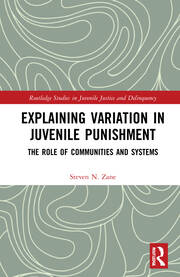
Explaining Variation in Juvenile Punishment The Role of Communities and Systems
Introduction: The Context of Juvenile Punishment
The Present Study
Book Overview
Chapter 1: The Mission and History of Juvenile Justice
Origins of Juvenile Justice
The First Juvenile Court
Child Saving: The Interventionist Vision of Juvenile Justice
The Failure of the Interventionist Vision
The Due Process Revolution
The Criminalization of Juvenile Justice
A More Punitive Juvenile Court
The Developmental Turn: Juvenile Justice in the Twenty-First Century
Conclusion
Chapter 2: The Contemporary Structure of Juvenile Justice
Juvenile Referrals
Preadjudication Detention
Intake and Petition of Delinquency
Waiver to Criminal Court
Adjudication of Delinquency
Judicial Disposition
State Variation in Juvenile Justice Processing
Chapter 3: Why Might Context Matter? Theoretical Perspectives on Juvenile Justice
Theoretical Frameworks for Juvenile Justice
Contextual Theories of Juvenile Justice
Conclusion
Chapter 4: Exploring the Influence of Community Characteristics: A Review of the Literature
Minority Threat
Economic Threat
Urbanism
Other Contextual Characteristics
Conclusion
Chapter 5: Data, Methods, and Analytical Approach
Research Hypotheses
Data and Sample
Measures
Analytical Strategy
Chapter 6: Multistate Findings, 2010
Variation in Juvenile Justice Outcomes
Contextual Effects
Summary of Findings
Chapter 7: Multistate Results, 2000
Variation in Juvenile Justice Outcomes
Contextual Effects
Summary of Findings
Chapter 8: State-Specific Results
County-Level Variation in Juvenile Justice Outcomes
Contextual Effects
Summary of Findings
Chapter 9: Does Context Matter? Discussing the Findings
Summary of Findings
State Variation in Juvenile Justice Outcomes
Study Limitations
Interpretation of Findings
Chapter 10: Implications for Research and Policy
Implications for Research
Implications for Policy
Concluding Thoughts
Appendices
Biography
Steven N. Zane, Ph.D., J.D., is an assistant professor in the College of Criminology and Criminal Justice at Florida State University. He received his Ph.D. from Northeastern University and his J.D. from Boston College Law School. His research focuses on juvenile justice, racial disparities, and evidence-based social policy, and has appeared in Criminology & Public Policy, JAMA Network Open, Journal of Criminal Justice, Journal of Quantitative Criminology, Justice Quarterly, and Youth Violence and Juvenile Justice.
