




1st Edition
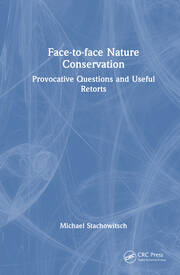
Face-to-face Nature Conservation Provocative Questions and Useful Retorts
About the Author
Preface
Acknowledgments
Introduction
1. General
2. Science
3. Extinction and Evolution
4. Terrestrial
5. Freshwater
6. Marine
7. Hunting and Fishing
8. Pets
9. Zoos and Public Aquariums
10. Natural History Museums
11. Pollution
12. Energy
13. Climate Change
14. Construction Projects and Zoning
15. Money and Jobs
16. Politics
17. Radicalism
18. Hairbrained Ideas
19. Pessimism/Nihilism/Cynicism
20. Activism and Helpful Souls
Index
Biography
Michael Stachowitsch is Senior Lecturer at the University of Vienna (Department of Functional and Evolutionary Ecology/Department of Paleontology). He is the author of more than 60 scientific publications (research focus: benthic marine ecology) and two other books, “The Invertebrates: An Illustrated Glossary” and “The Beachcomber’s Guide to Marine Debris.” In addition to currently lecturing on courses, including Introduction to Marine Pollution and Management of Endangered Species, Michael has engaged in long-term activities managing endangered species, specifically sea turtles. He is President of the Society for Science and Research, Vienna Aqua Terra Zoo (Haus des Meeres), and Austrian representative at the International Whaling Commission (Scientific Committee and Alternate Commissioner).
“This book will, I feel, help lift its readers from their doldrums and give them some answers and also a smile. It is lucid, witty, well informed and opinionated in a good way. Ideal for use by undergraduate students, lecturers can also use it to provoke discussion and debate. In the years that I taught Environmental Sciences at undergraduate level, I would have appreciated such a text!”
Mark P. Simmonds, OBE, Director of Science for OceanCare and Visiting Research Fellow at the University of Bristol, UK
“It is a major challenge for everyone working in nature conservation and environmental protection projects who are confronted with the general public to provide good answers to questions and to counter sometimes misguided or even provocative statements. This book is an enormous help in this regard and offers a rich source of possible answers. The topics accurately reflect the daily interactions we have as scientists on the front lines with skeptical members of the public.”
Patricia Holm, Emeritus Professor of Ecology, Dept. of Environmental Sciences, University of Basel, Switzerland
“There is a need for a novel-format book like this one, especially given the challenging times we live in with short attention spans, digital distractions, explosive reactions and temperaments, and escalating conflicts. I admire the novelty of the book and appreciate the intent as well as implementation. The succinct primer is a good jumping board for coming up with custom retorts using humour to respond to challenging questions and diffusing potentially conflict-inducing situations.”
Kadambari Devarajan, ecologist, writer, and National Geographic Explorer
“This book will fill a void in understanding and communication between various sectors and interest groups involved in work related to animals and the environment.”
Michael W Fox, veterinarian, medical scientist and ethologist, syndicated “Animal Doctor” newspaper columnist and author of One Health: Veterinary, Ethical & Environmental Perspectives, USA
“This light-hearted and ‘bite-sized’ issue-by-issue approach is useful for getting people connected with today’s scientific fascinations, but also the pressing issues with which we have to grapple but are doing so extremely sub-optimally today. It has the potential to engage curiosity and motivate with science, but also humour.”
Mark Everard, Associate Professor, University of the West of England, UK
