




1st Edition
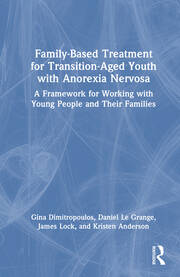
Family-Based Treatment for Transition-Aged Youth with Anorexia Nervosa A Framework for Working with Young People and Their Families
Introduction 1. What is FBT-TAY? 2. Why use FBT-TAY? The Scientific and Clinical Rationale 3. Overview of Late Adolescent and Young Development in FBT-TAY 4. Setting Up Treatment for FBT-TAY 5. Phase 1 – Session 1 6. Phase 1 – Session 2 (The Family Meal) 7. Remainder of Phase 1 8. Phase 2 9. Phase 3 – Emerging Adulthood, Relapse Prevention and Termination of Treatment 10. Contextual Considerations in FBT-TAY 11. Post-Secondary Considerations 12. FBT-TAY for Diverse Families 13. FBT-TAY for Young People Without Family Involvement 14. Book Summary and Conclusion
Biography
Gina Dimitropoulos is a professor at the Faculty of Social Work, University of Calgary, and is cross appointed with the departments of psychiatry and paediatrics.
Daniel Le Grange is an emeritus professor of psychiatry and behavioural sciences at University of California, San Francisco, and emeritus professor of psychiatry and behavioural neuroscience at the University of Chicago.
James Lock is a professor of child psychiatry and the director of the eating disorder program at Stanford University.
Kristen Anderson is a licensed clinical social worker and the co-founder of the Chicago Center for Evidence Based Treatment, a specialized eating disorders treatment program serving individuals with eating disorders across the lifespan.
“Dr. Dimitropoulos and her team have drawn on their wealth of knowledge in the areas of adolescent development and family systems as well as eating disorder treatment. In doing so, they have created a model that is both in line with cutting-edge scientific evidence and extremely patient-centered. This manual is an absolute necessity for anyone practicing in the eating disorders space, and offers an invaluable foundation of best practices for all clinicians and researchers hoping to effectively work with patients ages 16-25.”
Jocelyn Lebow, PhD, LP, Consultant, Division of Integrated Behavioral Health, Department of Psychiatry & Psychology, Mayo Clinic School of Medicine
“This seminal book provides guidance on the evidence-base, theory and rationale for providing Family-Based Treatment (FBT) for Transition Age Youth (TAY) with eating disorders. Further background is provided on the critical differences between traditional FBT and FBT-TAY. In addition, this book includes a detailed step-by-step guide to providing this treatment. Every clinician caring for youth aged 16-25 years will want to read this book!”
Jennifer Couturier, MD, MSc, FRCPC, Child and Adolescent Psychiatrist and Medical Co-Director, McMaster Children’s Hospital Eating Disorders Program; Professor, Department of Psychiatry & Behavioural Neurosciences, McMaster University
"This book offers a thoughtful and much-needed contribution to the evolving field of eating disorder treatment. What distinguishes this work is its careful balance of scientific rigor and clinical wisdom. The authors articulate the foundational principles of family-based care while demonstrating how these principles can be applied with greater developmental sensitivity for individuals navigating the transition to adulthood. By emphasizing collaboration with the young person alongside continued caregiver involvement, FBT-TAY reflects the realities of this life stage and honors the emerging autonomy of young adults without compromising the urgency of medical and nutritional recovery.
This book is a timely and important resource that advances both the science and practice of eating disorder care."
Dr. Karen Bernstein, Associate Professor of Pediatrics, University of Illinois Chicago
