




1st Edition
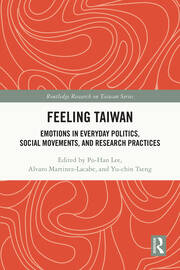
Feeling Taiwan Emotions in Everyday Politics, Social Movements, and Research Practices
1 Introduction: Why Emotion Matters in Rethinking Taiwan Studies
Po-Han Lee, Alvaro Martinez-Lacabe, and Yu-chin Tseng
Part 1 Affective Geopolitics and Incomplete Transitional Justice
2 ‘I’ve Never Been to Me’?
Apathy, Military Songs, and Transitional Justice in Taiwan
Chia-Yu Liang
3 Arts and Transitional Justice in Taiwan: An Affective Approach
Shaina P. Wang
4 Embracing Emotions in the Research Process:
Early Reflections in the Context of Studying Taiwan
Hsiao-Man Cavalli and Lily Y.H. Lin
5 Memes and Milk Tea Alliances: Reframing Geopolitical Discourses of Taiwan and its Neighbors Through Ludic Activism
Genevieve Leung and Ming-Hsuan Wu
Part 2 Emotional Colonisation and Coloniality in Multiple Forms
6 Expressing Emotions in a Colonial Text:Huang Fengzi’s Taiwan no shōjo (A Young Girl of Taiwan)
Anne Sokolsky
7 From Hong Kong to Taiwan:
A Reflexive Journey Through Emotion, Identity, and Community
Judy Yi-nga Lee
8 Destroyed Houses, Incomplete Lives: Suffering, Madness, and the Unfinished Project of Transitional Justice for the Tao of Lanyu
Yu-Yueh Tsai
9 Affective Dimensions of Han Settler Colonialism: Autoethnographic Reflections from a Transnational Taiwan Studies Scholar
Yang-Hsun Hou
Part 3 Intimacies, Sexualities, and Feeling Attached/Unattached
10 Making Multifaceted ‘Affective Relatedness’: Emotions in Gay Men’s Reproductive Orientations and the Researcher’s Navigations of Insider-Outsider Positionality
Jung Chen
11 From Swipe to Follow: Algorithmic Romance Work in Taiwan’s Digital Dating Culture
Wei-Ping Chen
12 Attached: The Refashioning of Affective Marginal Citizens in a Biomedical Era
Po-Chia Tseng
13 Visible Yet Absent: The Emotional Politics of Migrant Representation in Taiwanese Media
Chia-Yuan Huang
Part 4 Everyday Politics of Morality, Mundaneness, and Feelings
14 Emotions at Stake in the Lying Flat Phenomenon: Looking at Alternative Life Choices Among Taiwanese Youth
Amélie Keyser-Verreault
15 Am I a Qualified Researcher? Discomfort and Reflexive Practice in Feminist Disability Studies from a Non-Disabled Male Perspective
Chong-Min Su
16 Emotion as Important Public Health Data: COVID-19 Vaccine Hesitancy Among Low Socioeconomic Status Communities in Taiwan
Chen-I Kuan
17 Trans-Species Affect and Ecological Emotion: Reconfiguring the Taiwan Island with Shan-jiao-yu
Chun-Mei Chuang
Biography
Po-Han Lee is an Associate Professor in the Global Health Program and the Institute of Health Policy and Management at National Taiwan University. He is trained in International Law in Taiwan and holds a PhD in Sociology from the United Kingdom. His research and activism engage critically with issues of gender, sexuality, disability, and health justice, and his recent scholarship explores feminist, queer, and decolonial approaches to global health law and the politics of knowledge in human rights, aiming to connect theory with social transformation.
Alvaro Martinez-Lacabe is a postdoctoral research associate in the Department of Society and Environment at Queen Mary University of London. His research explores the intersections of critical public health, queer studies, and activist networks, with a particular focus on HIV/AIDS prevention and the use of pre-exposure prophylaxis (PrEP) for HIV. He has published in journals including Culture, Health & Sexuality, and Critical Public Health.
Yu-chin Tseng is an Associate Fellow at the European Research Center on Contemporary Taiwan, University of Tübingen. She previously served as a Junior Professor in the Department of Chinese Studies at Tübingen from 2018 to 2025. Her research critically examines migration, intimacy, and state power in politically sensitive regions, particularly China and Taiwan. Tseng has published in leading journals such as the Journal of Immigrant and Refugee Studies and the Journal of Contemporary China. Her interdisciplinary scholarship bridges sociology, migration studies, and Asian politics, offering incisive analyses of emotion, aspiration, and mobility within the context of global migration.
"
