




1st Edition
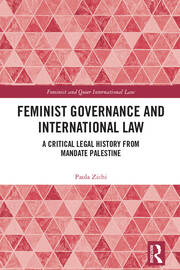
Feminist Governance and International Law A Critical Legal History from Mandate Palestine
Introduction, Chapter 1: Palestine and Interwar Feminisms – Communities, Associations, Institutions; Chapter 2: Personal Status Laws as Technologies of Global Governance; Chapter 3: Colonial Penality Laws as Technologies of Global Governance; Chapter 4: Policing Women’s Labour as Technologies of Global Governance ; Chapter 5: Palestine in the Global Context: Comparative Perspectives; Chapter 6: Conclusion.
Biography
Paola Zichi is a feminist legal scholar specializing in gender, history, and international law, with a particular focus on feminist histories and methodologies for legal research. She is currently a British Academy Postdoctoral Fellow at Warwick Law School, working on Feminist Lawyering and International Law in European History (1899–1949). Previously, she worked as an AHRC-funded postdoctoral researcher at the School of History, Queen Mary University of London (QMUL). Zichi completed her doctorate in Gender Studies at SOAS University of London. Her PhD project won the Helen Reece Prize, awarded by the Modern Law Review for the best PhD project in feminist legal studies. Her academic background bridges international law, history, criminology, and family law, with a particular emphasis on the intersections of gender, postcolonial theory, and legal history. Her work has been published in leading journals, and she serves on the editorial board of the Australian Feminist Law Journal. Her forthcoming book, Feminist Governance and International Law: A Critical Legal History from Mandate Palestine, explores the intersections of feminist activism and international institutions in the early twentieth century.
Shortlisted for the SLSA Early Career Book Prize
'Within this text, Paola Zichi offers a theoretically informed history of legal activism taking place in relation to Mandatory Palestine within feminist groups on a broad range of international issues, including the civic and familial status of women (Chapter 2), penal law and coloniality (Chapter 3), and labour and criminal regulation relating to policing, domestic and sex work, and human trafficking (Chapter 4). Each topic is rich in historical detail and robust in terms of critical analysis, rendering the book invaluable to anyone concerned not only with Palestine's particular history but also with how international law has, at various points, interacted with marginalised groups so as to complicate (and often frustrate) their collective and individual self-determination. Chapter 5, which takes a comparative view, is particularly fine in this regard, while Chapter 4 presents an important cautionary tale for how even well-meaning international efforts at ‘feminising politics’ can shore up the colonial domination of subject peoples. The book to this extent represents the best tradition of critical scholarship: one which abjures unhelpful theoretical abstraction and delivers contextually rich, nuanced analysis, never shying away from identifying instances of ambiguity and contention.'
Alex Green, Modern Law Review
