




1st Edition
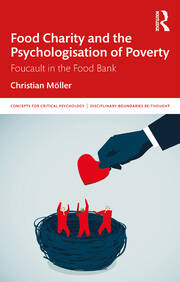
Food Charity and the Psychologisation of Poverty Foucault in the Food Bank
- Introduction: An Essay in Refusal
- ‘More than Food’ and Behaviour Change
- New Subjects of Charity
- Toward a Critical Ontology of Food Charity and the Psychologisation of Poverty
- Scope and Focus of the Book
2.1. "What is a Dispositive?"
2.2. Fuelling the Machine: Flows and Materialisations of Knowledge
2.3. The Spectacle of Food Charity: Neighbourhood Food Collections (NFCs)
2.4. Collection Points: Consuming Charity
2.5. Feeding the Worthy Poor
2.6. Poverty Relief as Spectacle
2.7. Failures in Disposition and Possible Resistance
2.8. Conclusion
- Problematisations in Foucault
- Constituting Problematic Subjects in the Food Bank
- Problematisation 1: Food Poverty as Sudden Crisis Driven by Structural Factors
- Problematisation 2: Food Poverty as Personal Chaos and Culture of Poverty
- Problematisation 3: Food Poverty as Result of a Failing Society
- Local Constructions of Food Poverty as a Social Problem
- Conclusion
- Crisis as Discourse: A Brief Genealogy
- The Constitution of ‘Clients in Crisis’
- A Nudge in the Food Bank
- Behavioural Activation and (not so) Soft Paternalism
- Conclusion
- ‘More Than Food’
- "Eat Well – Spend Less"
- Job Clubs and Social Spaces in Food Banks
- Conclusion
- From Vulnerability to Wellbeing: Happy Subjects of Charity?
- Disrupting the Spectacle and Killing Charity’s Joy
- Developing a Shockproof Subject?
- Refusing Resilience, Positivity and Development
- Conclusion
- Psychology, ‘Nudge’ Economics and Neoliberalism
- Liberalism and the Traps of Humanism
- Absent Voices and Poverty Research
- Essays in Refusal: The Value of Critique
- Critique is Not Enough: From "What’s to be done?" to "What more am I to do?"
References
Biography
Christian Möller is a Research Fellow in the School of Social Work and Social Policy at the University of Strathclyde, UK. He also teaches Critical Social Psychology as an Associate Lecturer at The Open University, UK. His main research interests are in critical discourse analysis, social and health inequalities and charity work.
'A necessary and multi-perspective analysis of contemporary food banks in the UK. A mandatory reading for all academic scholars and public activists interested in food poverty in a broader cultural context.'
Stefan Selke, Furtwangen University, Germany
'Through his critical and discursive approach, Chris Möller invites us to "think differently" about food charity. His incisive critique of our everyday assumptions about the psychology of both food poverty and food charity provides a rigorous theoretical analysis that is grounded in and illustrated by examples of his own research. Chris’s own reflections on his research experience, woven through his accounts of data collection, importantly personalise the political issues he raises. This book will be an important and timely resource for critical scholars of food poverty and food charity in psychology, sociology and related disciplines.'
Viv Burr, University of Huddersfield, UK
'In this book, Chris Möller explains exceptionally well why a political and discursive approach is needed to consider food banks in terms of the "psychologisation" of poverty, the spectacle of food banks and why food banks are actually part of a problem of neoliberal societies. Read it and then consider political practice and forms of social action to create social change in the world.'
Alex Bridger, University of Huddersfield, UK
