





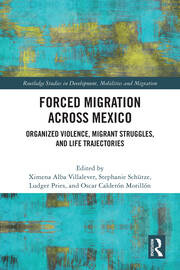
1st Edition
Forced Migration across Mexico Organized Violence, Migrant Struggles, and Life Trajectories
Table of contents
Chapter 1: Introduction: Approaches to organized violence and forced migration in transit through Mexico
Ximena Alba Villalever, Stephanie Schütze, Ludger Pries, and Oscar Calderón Morillón
Part I – The effects of violence and border regimes on migration processes
Chapter 2: Violence and Central American migrants on Mexico’s southern border
Martha Luz Rojas-Wiesner
Chapter 3: Entanglement of violences: Doubly forced migrants transiting across the Americas
Soledad Álvarez Velasco and Bruno Miranda
Chapter 4: Externalization, violence, and migrants’ lengthy wait at Mexico’s northern border
M. Dolores París-Pombo
Part II – Forced migrants’ experiences with organized violence
Chapter 5: Investigating in-transit migration through Mexico within the context of violence and the pandemic
Oscar Calderón Morillón, Amir Estrada, Marlene Rodríguez, Axel Ortiz, Karla Gutiérrez, Estefanía Gutiérrez, Aranza Climaco, Antonio Amat, Alan Rodríguez, Javier Solís, and Eusebio Moto
Chapter 6: Forced migration and organized violence between the Northern Triangle of Central America and Mexico: Evidence from a 2020 survey
Ludger Pries, Berna Şafak Zülfikar Savci, Ximena Alba Villalever, and Oscar Calderón Morillón
Chapter 7: Caravanas migrantes as counter-strategies against violence and (im)mobility
Ximena Alba Villalever and Stephanie Schütze
Chapter 8: Ties along the arterial border in Mexico: Groups, institutions, and information
Alejandra Díaz de León and John Doering-White
Part III – Gender and violence in migration trajectories
Chapter 9: Gendered patterns of mobility and access to refugee protection of Central American migrants and refugees in Mexico
Susanne Willers
Chapter 10: Organized violence in life histories of Central American migrant women
Melanie Nayeli Wieschalla
Chapter 11: Waiting as violence: The interactions of gender and waiting mechanisms in the asylum systems of the United States and Mexico
Pia Berghoff and Lya Cuéllar
Biography
Ximena Alba Villalever is an anthropologist, researcher, and professor in the Institute for Latin American Studies of the Freie Universität Berlin, where she is a coordinator of the Gender Studies profile of the Master’s program. Her research has focused on migration processes with a particular interest on gender, labor, inequality, globalization, and violence.
Stephanie Schütze is Professor for Cultural and Social Anthropology with a specialization in gender and migration studies at the Lateinamerika-Institut of Freie Universität Berlin. She has conducted research on political culture, social movements, migration, and gender relations in diverse contexts and regions in Mexico, the United States, and Brazil.
Ludger Pries held Chair of Sociology and is now Senior Professor at the Department of Social Science of Ruhr-University Bochum. He had longer teaching and research stays in Brazil, Mexico, Spain, and the United States. Fields of research are (international comparative) sociology of migration, work and organizations, life-course research, and transnationalism.
Oscar Calderón Morillón is Research Professor at the Faculty of Political and Social Sciences of the Benemérita Universidad Autónoma de Puebla. His lines of research are labor studies and migration processes in the contexts of exclusion and vulnerability.
"Forced Migration across Mexico is a timely volume that conceptualizes the root causes of violence in migrant trajectories. With a focus on theoretical frameworks, violence on the southern and northern borders, migrant caravans, and gendered patterns, this book provides a comprehensive understanding of the complex dynamics between migration and violence in Mexico."
Xóchitl Bada, Associate Professor in Latin American and Latino Studies, University of Illinois Chicago
