




1st Edition
Form Follows Fuel 14 Buildings from Antiquity to the Oil Age
Introduction - Form Follows Fuel
Methodology
1-2. You may be a Pharaoh: The Great Pyramid in Giza and the Seagram Building in New York
3. A Dwelling in a Low-Energy Society: Blackhouse in Arnol, Scotland
4. A Rammed-Earth Dwelling: Teleuk in Mourla, Cameroon
5. A Mausoleum in an Agrarian Empire: The Burial Mound of the First Chinese Emperor near Xī'ān
6. Monumental Architecture without Wheels, Iron or Draft Animals: The Great Temple in Tenochtitlan/ Mexico City
7. Leisure from the Emperor: The Baths of Caracalla, Rome
8. Fossil Coal and Capitalist Growth: a Georgian House at 36 Great James Street, London
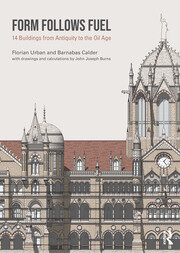
9. The Transport Revolution: Chhatrapati Shivaji Maharaj Terminus, Mumbai
10. Early mass housing in an industrial city: Tenement at Rostocker Straße 44, Berlin
11. Early mass housing in a colonial context: Jianyeli Lilong ensemble, Shanghai
12. The Modern Factory: Original Assembly Building at the Ford Plant in Highland Park near Detroit
13. Mass housing at its peak: Panel Block at Ulitsa Grimau 14, Moscow
14. The Contemporary Airport: Kuala Lumpur International
15. Conclusion: Architecture for the Post-Oil Era?
Annex 1: Basic Energy Figures
Annex 2: Human Labour, an Elusive Quantity
Biography
Florian Urban is an architectural historian, Professor, and Head of History of Architecture and Urban Studies (HAUS) at the Glasgow School of Art. He was born and raised in Germany, and holds an MA in Urban Planning from UCLA and a PhD in History and Theory of Architecture from MIT. He is the author, among others, of the books Neo-historical East Berlin – Architecture and Urban Design in the German Democratic Republic 1970–1990 (2009), Tower and Slab – Histories of Global Mass Housing (2012), The New Tenement – Architecture in the Inner City since 1970 (2018), and Postmodern Architecture in Socialist Poland – Transformation, Symbolic Form and National Identity (2021). @florianurban.bsky.social
Barnabas Calder is a historian of architecture and Head of the History of Architecture Research Cluster at the University of Liverpool. He specialises in the relationship between architecture and energy throughout human history. He also works on British architecture since 1945, and on the intersections between energy systems and human culture. He is the author of Raw Concrete: The Beauty of Brutalism (2016) and Architecture: From Pre-history to Climate Emergency (2021). @barnabascalder.bsky.social, Insta: @BarnabasCalder, #ArchitectureAndEnergy
"If we want to succeed in addressing climate change, we must offer a compelling social vision alongside technical solutions. The book Form Follows Fuel by Florian Urban and Barnabas Calder, despite its technical tone, is one such work. It offers a clear-sighted view of reality and the past while opening perspectives for a future architecture that may once again regain its lost socio-emancipatory potential."
Peter Szalay, Review in Architektúra & urbanizmus Volume 59, Number 3 – 4
