





1st Edition
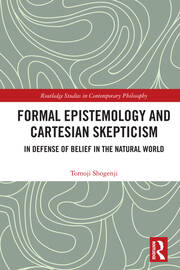
Formal Epistemology and Cartesian Skepticism In Defense of Belief in the Natural World
Introduction
1. Skepticism and the Method of Meliorative Epistemology
2. Truth as Correspondence
3.The Myth of Epistemic Circularity
4. Dual Components of Epistemic Evaluation
5. A Bayesian Case for Skepticism
6. Divergences from the Truth
7. Cartesian Skepticism Defeated
Biography
Tomoji Shogenji teaches philosophy at Rhode Island College. His main area of research is formal epistemology, and his publications include "Is coherence truth conducive?" (Analysis 1999) and "The Degree of epistemic justification and the conjunction fallacy" (Synthese 2012) among many others.
"The book is a formal epistemological delight. Shogenji's work is characteristically fascinating, careful, and clever." – Notre Dame Philosophical Reviews
"This groundbreaking book is a bold, and much needed, attempt to bridge formal and traditional epistemology. It employs Bayesian reasoning to confront Cartesian skepticism and other classical philosophical puzzles. Indeed, the book even goes beyond Bayesianism and covers recent proposals on which active research is taking place at the moment." – Gustavo Cevolani, IMT School for Advanced Studies Lucca, Italy
"Shogenji’s book is a highly important, comprehensive and encouraging work within the program of meliorative epistemology. Shogenji identifies the central problems faced by contemporary epistemology and designs solutions for them that are, on the one hand, supported by methods applied in contemporary science and, on the other hand, applicable as a guide for our epistemic practice. Shogenji’s book is recommended to anyone interested in a comprehensive treatment of the problems faced by contemporary epistemology within a scientifically minded and meliorative perspective." – Gerhard Schurz, Heinrich Heine Universität Düsseldorf, Germany"The book is an important attempt to bridge formal and traditional epistemology. In addition, the book offers insightful discussions on a number of issues and sheds new light on them. Anyone interested in either formal epistemology or traditional epistemology will have much to learn from the book. For anyone interested in both, it is a must-read." – Masashi Kasaki in Annals of the Japan Association for Philosophy of Science
