




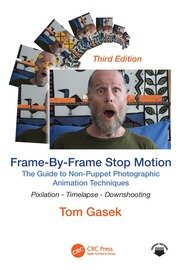
3rd Edition
Frame-By-Frame Stop Motion The Guide to Non-Puppet Photographic Animation Techniques
Acknowledgments
Introduction
Chapter 1: What are the Possibilities?
Creating Magic
Silent Films
Stop Motion and its Various Faces
Chapter 2: Shooting Frame by Frame
Technique to Serve The Idea
Pre-Production
Setting Up
Equipment
Software
Chapter 3: Pixilation
Take Advantage of the Medium
Who is the Director?
Humor
Shooting on Two’s
Animation Principles
The Moving Camera
Critique 1- OMOZOC
Chapter 4: Time Lapse
The Intervalometer
Expand your Awareness
Understand Your Subject
Contrast
The Time Lapse Formula
Time Lapse & Pixilation
Shutter Speeds
Motion Control
Chapter 5: Cinematography, Lighting and Composition
Cameras & Lenses
Manual Controls
Controlled Lighting
Shadows
Compositional Beginnings & Ends
Zooms, Tracks, Pans and Tilts
Animated Lighting
Shooting Formats
Chapter 6: Objects, People & Places
Objects and Rigging
Organic and Non Organic Objects
Demanding Work for the Actor
The Actor as Animator
Outside and Inside Shooting
The Studio
A Shooting Safe Zone
Critique 2 – dina Amin
Chapter 7: The Multiplane Down-shooter
The Traditional Animation Stand
A Stand of Your Own
Lighting for the Down-shooter
Working on Glass
Clay, Sand, Dimensional Objects
Cut Outs
Background
Green Screen
Chapter 8: Collage (The Digital Advantage)
Planning a collage
The Rotoscoping Function
Match Lighting
Photoshop
Cleaning Rigs
Multilayering in After Effects
Chapter 9: Visual Rhythm
Let the Music Lead
The Effects of Sound
Tight Cutting
Patterns of Movement
Consistent Movement
Frame Rates
Critique 3 – Kevin Parry
Chapter 10: A Sense of Drama
Live Action and Single Framing
Subtle and Broad Performance
Reference Filming
The Cartoon
The Wide Angle Lens
The Close-Up
Body Language
Chapter 11: Massaging Frames in the Edit
Pulling Frames
Duplicating Frames
Shooting for Post
Post Up Front
Mixing in Live Action
Matching for Composite
Effects Practical & Post Generated
Reverse the Playback
Chapter 12: Off to the Market
Now what ?
Record & Archive the Process
Venues for “Experimental Techniques”
Websites and the Internet
Festival Exposure
Ownership
Critique 4 – Tom Gasek
Biography
Tom Gasek is a Professor Emeritus at Rochester Institute of Technology (RIT) where he taught in the School of Film and Animation for 19 years. He worked as a professional director and animator for 26 years prior to teaching with animation credits that include Aardman Animations’ The Wrong Trousers and Chicken Run as well as Laika’s Coraline. He operated several small studios of his own including the award‑winning, Sculptoons in San Francisco. Gasek is a Fulbright Specialist and wrote the only book on "non‑puppet stop motion." He just completed his third independent film called 4 @ 60, which includes "non‑puppet" stop motion techniques.
“This book is a wonderfully inspiring, accessible and thorough guide to a number of techniques that have been seldom written about or charted before. It is an essential manual for any student, professional or creative person who has ideas - and wants to be encouraged with a sense of “I could do that” – and wants to get their ideas out there. I just wish this book had been written when I was a student of animation (I still am, so I will buy it anyway).” -- Nick Park, Academy Award winner and creator of Wallace and Gromit.
“A must-have book for any animator’s library. Frame by Frame is a reminder of all the magical possibilities animation has to offer and all you need is a camera and an idea.” -- Jim Capabianco, Filmmaker / Director of “The Inventor”
“Tom’s extensive experience as a stop motion animator, combined with his knowledge of the field and his natural teaching ability, make this book a clear, well-organized, and empowering introduction to stop motion animation. This book will be an invaluable resource for student and teacher alike.” -- Steven Subotnick, animator, educator and author of Animation in the Home Digital Studio
“In the digital age it pays to remember that innovative ideas can still be inspired using even the most basic techniques. This book is a timely reminder that a rewarding process depends as much on ingenuity as it does on facility.” -- Dave Borthwick, animation director, Bolex Brothers
