




1st Edition
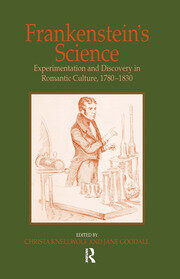
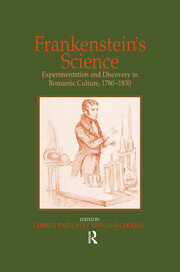
Frankenstein's Science Experimentation and Discovery in Romantic Culture, 1780–1830
240 Pages
by
Routledge
240 Pages
by
Routledge
240 Pages
by
Routledge
Also available as eBook on:
Though Mary Shelley's Frankenstein has inspired a vast body of criticism, there are no book-length studies that contextualise this widely taught novel in contemporary scientific and literary debates. The essays in this volume by leading writers in their fields provide new historical scholarship into areas of science and pseudo-science that generated fierce controversy in Mary Shelley's time:... Read more
Contents: Introduction, Christa Knellwolf and Jane Goodall; Educating Mary: women and scientific literature in the early 19th century, Patricia Fara; The professor and the orang-outang: Mary Shelley as a child reader, Judith Barbour; Geographic boundaries and inner space: Frankenstein, scientific explorations and the quest for the absolute, Christa Knellwolf; Animal experiments and anti-vivisection debates in the 1820s, Anita Guerrini; Monstrous progeny: the teratological tradition in science and literature, Melinda Cooper; Shadows of the invisible world: Mesmer, Swedenborg and the spiritualist sciences, Joan Kirkby; Electrical romanticism, Jane Goodall; Evolution, revolution and Frankenstein's creature, Allan K. Hunter; Science as spectacle: electrical showmanship in the English Enlightenment, Ian Jackson; Collectors of nature's curiosities: science, popular culture and the rise of natural history museums, Christine Cheater; The nightmare of evolution: H.G. Wells, Percival Lowell and the legacies of Frankenstein's science, Robert Markley; Bibliography; Index.
Biography
Christa Knellwolf is a Visiting Professor of English and Cultural Theory at the University of Konstanz and an Adjunct Associate Professor at the Australian National University. She has published widely on the age of Enlightenment and the cultural impact of science and exploration. Jane Goodall is a Professor with the Writing and Society Research Group at the University of Western Sydney, Australia.
'This ably edited volume explores the myriad scientific contexts in which Mary Shelley's Frankenstein came into being ” her childhood reading; contemporary geographical explorations, especially to the Arctic Poles; debates concerning human and animal vivisection, monstrous births, spiritualism, electricity, evolution, and the mania for collecting specimens of natural history. These essays deeply enrich our understanding of Shelley's novel, its impact on later historical readers, and its continuing relevance to current scientific controversies.' Anne K. Mellor, UCLA, USA ’This scholarly yet accessible volume is a valuable resource, not just for students of Mary Shelley but also for all those interested in the history of science in the late 18th and early 19th centuries.’ Times Higher Education 'There are some remarkable essays here, notably on the expanding boundaries of nineteenth-century science and social reform.' Enlightenment and Dissent
