




1st Edition
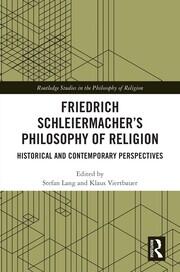
Friedrich Schleiermacher’s Philosophy of Religion Historical and Contemporary Perspectives
1. Introduction
Stefan Lang and Klaus Viertbauer
Part 1: Historical Constellations
2. More than Conceivable and Unlike Anything Else: The Idea of God in Kant and Schleiermacher
Ingolf U. Dalferth
3. Schleiermacher’s Engagement with Fichte: The Case of the Overlooked Gesetzt
Jeffery Kinlaw
4. “[T]here Is No Religion of Reason”: Schelling and Schleiermacher on the Independence of Religion
Christian Danz
5. Hegel’s Criticism of Schleiermacher and the Question of the Origin of Faith
Jon Stewart
6. Is Kierkegaard a Successor of Schleiermacher?
Klaus Viertbauer
7. Into the Being of There and Beyond: Heidegger’s Debt to Schleiermacher
Jacqueline Mariña
Part 2: Conceptual Considerations
8. The Transcendent Ground in Schleiermacher
Manfred Frank
9. Human Individuality in Friedrich Schleiermacher’s Christology
Johannes Zachhuber
10. From Remorse to Blessedness: Religious Feelings in Schleiermacher’s Theology
Anne Käfer
11. Religious Experience as Inescapably Particular, or as a General Feature of Human Consciousness? A Critical Analysis of Schleiermacher’s Argumentation in §§ 3 and 4 of The Christian Faith (1830/1831)
Maureen Junker-Kenny
Part 3: Contemporary Perspectives
12. The Reception of Schleiermacher in German-Speaking Theology 1834–1923
Friedemann Voigt
13. Schleiermacher and Catholicism
Benjamin Dahlke
14. “They Called All These Feelings Piety”: Schleiermacher and Modern Philosophy of Emotions
Roderich Barth
15. Friedrich Schleiermacher, Feminist Philosophy, and Religion: A Reappraisal
Katherine Faull
16. What is ‘Religious Experience’ in Schleiermacher’s Dogmatics, and Why Does It Matter?
Andrew C. Dole
Biography
Stefan Lang is Privatdozent at the Martin Luther University in Halle/Salle, Germany. His research focuses on the philosophy of mind and classical German philosophy. He is the author or (co‑)editor of Performatives Selbstbewusstsein (2019), “Self‑Consciousness Explained” (Review of Philosophy and Psychology 2022), and Performativität in der Klassischen Deutschen Philosophie (2024).
Klaus Viertbauer serves as Akademischer Rat at the University of Weingarten, Germany. He has authored two monographs, around 50 articles, and over 15 edited volumes, including the special issues “Habermas on Religion” in the European Journal of Philosophy of Religion (2019), “God and Morality” in The Monist (2022), and “Self‑Consciousness Explained” in the Review of Philosophy and Psychology (2022).
"In the volume, Friedrich Schleiermacher’s Philosophy of Religion: Historical and Contemporary Perspectives, leading scholars from both sides of the Atlantic explore historical, philosophical, and conceptual facets of Schleiermacher’s thought to claim Schleiermacher as relevant interlocutor to contemporary discussions in theology and philosophy. This book underscores the importance of Friedrich Schleiermacher as a theorist of religion."
Christine Helmer, Peter B. Ritzma Professor of Humanities, Northwestern University, Evanston, Illinois, USA
"This volume represents the best of the New Schleiermacher Research, which is fueled by the new critical edition of Schleiermacher’s works published by De Gruyter (Friedrich Schleiermacher: Kritische Gesamtausgabe). The contributors are all leading scholars in Schleiermacher-Studies and in the Philosophy of Religion more generally. As promised in the subtitle (“Contemporary Perspectives”), it corrects older, tired assumptions about Schleiermacher as it also stakes out new territory—for instance, Schleiermacher’s relevance to recent cognitivist theories in the philosophy of emotion. Those new perspectives are also at work in the “historical” and “conceptual” sections of the book. Every chapter is fresh, clear, and insightful. Schleiermacher scholars will learn something new; philosophers of religion will be reminded of how influential Schleiermacher continues to be and how unreliable standard interpretations of him have been; and non-specialists will find substantive, interesting, and trustworthy portals into difficult topics. Lang and Viertbauer have organized an impressive collection of essays that together will prove indispensable to the field."
Julia A. Lamm, Professor of Theology and Religious Studies, Georgetown University, USA
