




1st Edition
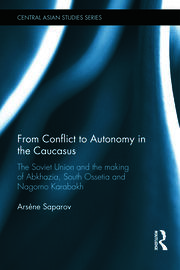
From Conflict to Autonomy in the Caucasus The Soviet Union and the Making of Abkhazia, South Ossetia and Nagorno Karabakh
Introduction
1. Caucasus between Empires 1801-1918
2. Abkhazia 1917-1931
3. South Ossetia 1918-1922
4. Nagorno-Karabakh 1918-1921
5. Towards Karabakh autonomy 1921-1925
6. Arbitrary Borders? The Bolsheviks Drawing Boundaries in the South Caucasus
7. From Autonomy to Conflict 1921 – 1991
Conclusion
Biography
Arsène Saparov received a PhD in International Relations from the London School of Economics, UK, in 2007. He now teaches Russian/Soviet and Caucasian history at the University of Michigan, Ann Arbor, USA. His research focuses on ethnic conflicts in the Caucasus, and Russian and Soviet history.
Saparov's concentrated study expands understating of Soviet nationality policy, and demonstrates how the peoples of the South Caucasus navigated it. - M. Chakars, Saint Joseph's University
Overall, in terms of aims and analyses, Saparov’s book has the potential to be an outstanding work, dealing with the very complex subject that is boundary making in Abkhazia, South Ossetia and Karabakh. This book is a useful source to all researchers and students who are interested in ethnic conflict, nation building and conflict resolution in the former Soviet Union. - OHANNES GEUKJIAN, American University of Beirut, Beirut, Lebanon
