




1st Edition
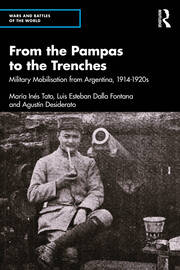
From the Pampas to the Trenches Military Mobilisation from Argentina, 1914–1920s
Introduction Part I: From the Pampas… Chapter 1: Pro Patria Mori: The Response to the Call to Arms Chapter 2: The Nerve of War: The Economic Support for Mobilisation Chapter 3: Meeting Poseidon: The Maritime Journey to Europe Part 2: …To the Battlefields… Chapter 4: Combat experiences Chapter 5: War’s Toll: The Wounded and the Fallen Part 3: …and Back Chapter 6: Coming Full Circle: Demobilization and Return Chapter 7: Lest We Forget: War Memorials
Biography
María Inés Tato is Principal Researcher at the National Scientific and Technical Research Council, Argentina.
Luis Esteban Dalla Fontana is Director of the master’s programme in War History at the Superior War College, Army Faculty, National Defence University (UNDEF), Argentina.
Agustín Daniel Desiderato is Professor of War History, Superior War College, Army Faculty, National Defence University (UNDEF), Argentina.
‘That the First World War was a global war with myriad faces and violent responses is none more evident than in this thoughtfully researched volume on the military contributions made from neutral Argentina. This book offers a history of the complex interplay between belligerency and neutrality in this pivotal global conflict.’
Maartje Abbenhuis, Ahorangi Professor in Modern History, Waipapa Taumata Rau University of Auckland, New Zealand
‘While various historians have recently shown that Latin America was profoundly affected by the Great War, the military mobilisation of these societies remained a blind spot. This book happily fills the gap. In Argentina, neutral until the armistice, the physical experience of mass violence was a reality whose memory remained vivid for several decades.’
Olivier Compagnon, Professor of Latin American History, New Sorbonne University, France
