




1st Edition
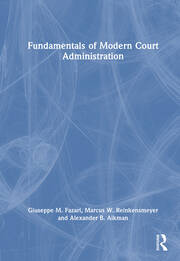
Fundamentals of Modern Court Administration
1. Introduction And Fundamental Areas Of Modern Court Administration 2. Purposes And Responsibilities Of Courts 3. Court Culture 4. Court Leadership 5. Caseflow Management 6. Judicial Branch Human Resources Management And Consultation 7. Court Funding And Budget Management 8. Court Operations Management 9. Court Information Technology Management 10. Court Community Engagement 11. Court Stakeholder Collaboration 12. Court Strategic Management And Master Planning 13. Conclusions: The Evolving Practice Of Court Administration
Biography
Giuseppe M. Fazari is a professor of criminal justice at Monmouth University and a former chief administrator and court executive for the New Jersey Judiciary. His Management Musings column appears quarterly in the NACM Court Manager, and he is the author of Courthouse Confidential. He serves as Regional Vice President of the IACA. He holds an MPA and a Ph.D. in higher education administration from Seton Hall University and is a Fellow of the Institute for Court Management.
Marcus W. Reinkensmeyer is Dean for the Institute for Court Management Fellows Program, National Center for State Courts. He has served as an administrator at the state and local court levels in Arizona and Illinois, a presenter, consultant, and Past NACM President. He presently serves on the IACA North American Regional Board. He holds a BFA from Michigan State University, an MPA from Northern Illinois University, and is a Fellow of the Institute for Court Management.
Alexander B. Aikman is a former executive of the National Center for State Courts and served as a management consultant to scores of trial and appellate courts nationwide. He was the Deputy State Court Administrator of Oregon and a court administrator of El Dorado County Superior Court, California. He has taught numerous courses on court administration and is the author of The Art and Practice of Court Administration. He holds a JD and LL.M. from The University of Chicago.
This book is a must-read for anyone who values the integrity of the judicial system and the effective delivery of justice. Court administration has evolved far beyond its historical focus on preserving the king’s peace and purse or accommodating the chief judge. The authors clearly trace this evolution and explain the increasingly complex demands of modern court management. They thoughtfully examine the purposes and responsibilities of courts and the wide array of legitimate stakeholders they serve—far more diverse and nuanced than those of private-sector organizations driven primarily by shareholder interests. Beginning with leadership, the book demonstrates how essential skills and practices can be aligned to engage stakeholders and foster a court culture that delivers justice effectively and consistently. Fundamentals of Modern Court Administration is both a practical guide and a compelling argument for reform. I strongly recommend it to judges and court administrators alike, particularly those seeking a more collaborative, sustainable model of court governance.
– Hon. Pamela Dembe
Fundamentals of Modern Court Administration is a rare and timely contribution to a field that is central to the rule of law yet too often underserved by comprehensive scholarship. Blending theory with real-world practice, the authors illuminate, among other important fundamentals, the essential roles of leadership, culture, caseflow, technology, and community engagement in delivering justice effectively. This book is an indispensable resource for judges, court administrators, scholars, and students committed to strengthening courts in an increasingly complex world.
– Pamela Harris
Maryland State Court Administrator (Ret.)
President International Association for Court Administration
Fundamentals of Modern Court Administration stands as a seminal contribution to the global literature on judicial systems. Unique in its scope and intellectual ambition, this volume offers an incisive, elegantly structured framework that speaks to the operational demands of contemporary courts, and to the deeper institutional values that sustain the rule of law and uphold legal certainty across jurisdictions. From an international vantage point, the work is nothing short of indispensable. The authors succeed admirably in weaving together theory, practice, and comparative insight, providing a consistent paradigm for understanding the complex ecology of the administration of justice. Their analysis of leadership, culture, case flow, technology, and community engagement demonstrates scholarly rigour and a profound understanding of how courts must evolve to deliver justice that is timely, accessible, and worthy of public trust. This book is, in every respect, a masterwork achievement -authoritative, illuminating, and richly deserving of the widest readership.
– Luis Maria Palma
Professor of Court Administration and Judicial Studies, Argentina and International Universities
Past President International Association for Court Administration
Students and practitioners of court administration have long sought guidance in learning and refining their craft. Fundamentals of Modern Court Administration is a rare and invaluable contribution that delivers. Drawing on decades of experience, scholarship, and practice, the authors bridge the long-standing gap between theory and the real-world demands of leading courts. This book thoughtfully examines not only how courts function, but why they exist, grounding modern administrative practice in enduring judicial purpose. Its treatment of leadership, culture, caseflow management, operations, technology, human resources, strategy, stakeholder collaboration, funding, and community engagement reflects a deep understanding of the complexity of courts as institutions and human organizations. Equally important, the authors emphasize sustainability – developing systems, leaders, and practices that endure beyond individual tenures. Students of court administration, emerging leaders, and seasoned executives will find this book indispensable. It belongs on the desk of anyone committed to strengthening the judiciary’s capacity to deliver justice fairly, effectively, and with public trust.
– David W. Slayton
Court Executive Officer, Superior Court of Los Angeles County
Past President National Association for Court Management
