




1st Edition
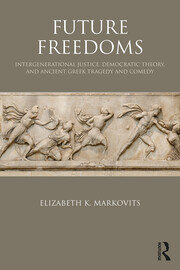
Future Freedoms Intergenerational Justice, Democratic Theory, and Ancient Greek Tragedy and Comedy
Introduction
1. Intergenerational Justice and Democratic Theory
2. A Narrative Turn
3. Archê, Finitude, and Community in Aristophanes
4. Mothers, Powerlessness, and Intergenerational Agency in Euripides
5. Freedom, Responsibility, and Transgenerational Orientation in Aeschylus
6. Art, Space, and Possibilities for Intergenerational Justice in Our Time
Biography
Elizabeth K. Markovits is Associate Professor of Politics and Director of the Teaching & Learning Initiative at Mount Holyoke College. Her research interests range from ancient Greek thought to contemporary feminist and democratic theory. She is the author of The Politics of Sincerity: Frank Speech, Plato, and Democratic Judgment (PSUP, 2008). She has also published scholarly articles on Greek comedy and tragedy, rhetoric, and on women, carework, and democracy, as well as numerous op-eds.
'Future Freedoms is a unique and wonderful blending of political theory and the interpretation of literary and material texts. Markovits’s initial argument is that the reason modern Western theorists find it so difficult to think about intergenerational justice is because they are blinded by a pair of disabling fantasies: the fantasy of sovereignty (both individual and collective), and the fantasy of inevitable historical progress toward such sovereignty. The way out of this dead-end, Markovits argues, drawing on Arendt, is not by formulating yet another abstract analytic theory, but by focusing on stories or narratives that link past, present, and future in "untimely" and unsettling ways that challenge our imagination of who we are and what we should want as individuals and citizens. Her insightful readings of two types of such narratives, ancient Athenian drama and modern public art, mark out new paths for thinking not only about the meaning of intergenerational justice but of democratic politics as well.' - Stephen Salkever, Bryn Mawr College
'Future Freedoms is a truly impressive work. With a nuanced approach to narrative as political theory, Markovits simultaneously offers innovative readings of ancient comedy and tragedy and pushes the boundaries of our thinking about intergenerational politics. Future Freedoms is a must read for students of the ancient Greeks and for contemporary democratic theorists.' - John Zumbrunnen, University of Wisconsin
'What kind of world will be left for future generations? Elizabeth K. Markovits’ Future Freedoms invites you to consider this question as a democratic one, drawing on a tradition of ancient and modern thought to envision how people can sustain democracy into the future. Lucid, imaginative, and cogent, this book is a necessary riposte to the de-democratizing forces dominant at the present moment as well as an exhortation to become the change you want to see.' - Joel Alden Schlosser, Bryn Mawr College
