




1st Edition
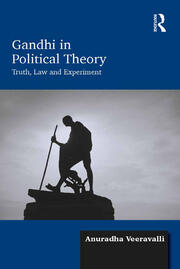
Gandhi in Political Theory Truth, Law and Experiment
By Anuradha Veeravalli
Copyright 2014
166 Pages
by
Routledge
166 Pages
by
Routledge
Also available as eBook on:
Can Gandhi be considered a systematic thinker? While the significance of Gandhi’s thought and life to our times is undeniable it is widely assumed that he did not serve any discipline and cannot be considered a systematic thinker. Despite an overwhelming body of scholarship and literature on his life and thought the presuppositions of Gandhi’s experiments, the systematic nature of his intervention... Read more
Preface, Anuradha Veeravalli; Chapter 1 Introduction: Truth, Law and Experiment in Political Theory, Anuradha Veeravalli; Chapter 2 Presuppositions of War and Peace: The Mind, the World and the Law of Non-violence, Anuradha Veeravalli; Chapter 3 Sovereignty: Individual, Civil Society and the State, Anuradha Veeravalli; Chapter 4 Territory: Nationalism, Identity and Frontiers, Anuradha Veeravalli; Chapter 5 The Science of Peace: Industrialization and the Political Economy, Anuradha Veeravalli; Chapter 6 Presuppositions of Pluralism: Experiments in Unity, Equality, and Difference, Anuradha Veeravalli;
Biography
Anuradha Veeravalli is an Assistant Professor at the University of Delhi. Her teaching and research focus on issues regarding science, religion and politics and the relation between them through a consideration of their epistemological presuppositions in a comparative perspective.
’Anuradha Veeravalli provides us with a provocative study of Gandhi’s political theory. Gandhi is seen as a systematic thinker who rejects the many dualisms that dominate much modern political thought. The author not only knows her Gandhi very well but also demonstrates a keen command of Western political thinkers. In this book, Gandhi takes on not only British colonialism but also the Enlightenment and the modern nation state.’ Ronald Terchek, Professor Emeritus, University of Maryland, USA
