





1st Edition
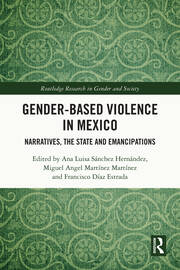
Gender-Based Violence in Mexico Narratives, the State and Emancipations
Introduction
Ana Luisa Sánchez Hernández and Miguel Angel Martínez Martínez
1. Gender and Necropolitics in Mexico
Ana Laura Velasco Ugalde
2. Drug Trafficking in the Tarahumara Sierra: An Approach from Colonial / Gender / Sexual Violence
Fátima del Rocío Valdivia Ramírez
3. Systemic Sexual Violence against Women in the Context of Armed Violence and Militarization: The Mexican Case
Viridiana López Herrera, Giselle Yáñez Villaseñor and Daira Arana Aguilar
4. Health is walked... In Search of Territorial Health in Contexts of Slow Violence: Insurgencies of Organized Women in the Border Region of Chiapas
Delmy Tania Cruz Hernández
5. Gender Violence: Racism, Classicism, and Femigenocide
Miguel Angel Martínez Martínez
6. Structural Transformations or the Politics of Simulation? The Gender Perspective in Higher Education
Manuel Méndez Tapia and Mauricio List Reyes
7. The Gender Effects of the Militarization of Migratory Controls in Mexico: Violence against Migrant Women Perpetrated by the State
Alethia Fernández de la Reguera Ahedo
8. Normative Frameworks of Gender-Based Political Violence in Mexico
Adriana Báez Carlos and Sergio Arturo Bárcena Juárez
9. State Control of Violence against Women: A Proposal with an Indigenous Cosmovision
Juliana Vivar Vera
10. Logics of the State and Sexualization of the Enemy: Power, Sovereignty and Indecency
Miguel Angel Martínez Martínez and Francisco Díaz Estrada
11. Political Transitions, Commissions of Truth, and Gender in Mexico
Ana Luisa Sánchez Hernández
12. Social Hostility and Peace Claims: Rethinking Gendered Migration from some Philosophical Categories
Dora Elvira García-González
13. Informative Sources on Victims and Perpetrators of Femicide in the Mexican Press
Elizabeth Tiscareño García, Óscar Mario Miranda Villanueva and Santiago Gallur Santorun
14. Digital Civics and Female Agency: The Case of the Group of the Mothers of Por Amor a Ellxs
Salvador Leetoy-López and Ana Cepeda-Jaramillo
15. Deported Mothers and their Voices in Humanizing Deportation Digital Archive: Domestic Violence and Resistances
Maricruz Castro Ricalde
16. The Social Function of Representing Violence against Women in Contemporary Mexican Documentary Film
Estefanía Arcadia Guerrero, Blanca Arcadia Guerrero and Diego Zavala Scherer
Postscript: It does not End here
Miguel Angel Martínez Martínez and Ana Luisa Sánchez Hernández
Biography
Ana Luisa Sánchez Hernández is a cataloguer of the Archives of Repression project at Article 19. In 2022, she completed a postdoctoral stay at Monterrey Institute of Technology and Higher Education (ITESM), Mexico. She teaches in the Department of Communication at the University of the Americas (UDLAP), Mexico. Her research topics have revolved around subjectivities, resistance and state violence.
Miguel Angel Martínez Martínez is currently a member of the National System of Researchers and a researcher for the Science and Technology Council of the State of Puebla (CONCYTEP). He is also member of Researchers for Mexico. His interdisciplinary research draws upon philosophy, literature and psychoanalysis to address issues on the production of corporealities and subjectivities, public spaces, violence and human rights.
Francisco Díaz Estrada is Dean of Research of the School of Humanities and Education at Monterrey Institute of Technology and Higher Education (ITESM), Mexico. He is also a member of the National System of Researchers and has lectured at universities such as San Carlos University in the Philippines, the Technological Institute of Costa Rica and the Pontificia Universidade Católica do Rio Grande do Sul (PUCRS), Porto Alegre, Brazil. His research focuses on Judeo-Christian philosophical thought and the social phenomena of exclusion and social marginalization.
