




1st Edition
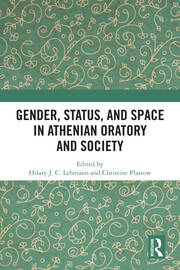
Gender, Status, and Space in Athenian Oratory and Society
List of Contributors
Acknowledgements
Introduction - Hilary J. C. Lehmann and Christine Plastow
1. Identification of citizen women in the Attic orators. A reconsideration from Demosthenes 27–29 and 44 - Nicolas Siron
2. Women and place in the speeches of Isaios - Allison Glazebrook
3. Do you even lift, bro? Sport and embodied masculinities in the Attic orators - Jessica Penny Evans
4. The stammering barbarian: the body politics of villainy in the speeches of Aeschines - Allison Das
5. Punishing the disadvantaged: status-defining penalties and their ideology in classical Athens - Janek Kucharski
6. The portrayal of slaves in forensic oratory and the connection with enslaved people in real life - Eleni Volonaki
7. Labor, agency, and the condition of slaves and freedpersons in 4th century Athens - Javal Coleman
8. Metics across boundaries: inhabitants’ polis and spatial narratives in Athenian forensic oratory - Mengzhen Yue
9. The spaces of insult in the corpus of Attic orators - Jean-Noël Allard
10. Reimagined space in the orators - Guy Westwood
11. Space and reconciliation in Athens after the Thirty - Christine Plastow
12. Topographies of affection: the space of kinship in Athenian inheritance speeches - Hilary J. C. Lehmann
13. Domestic space and Aphobus’ guilt in Demosthenes 27, The First Speech Against Aphobus - Peter A. O’Connell
Index
Biography
Hilary J. C. Lehmann is an associate professor of classics at Knox College (Illinois). Her research focuses on representations of home and family in Athenian rhetoric, intersections of mobility and identity in Athenian drama, and narrative desire in Herodotus and the ancient Greek novel.
Christine Plastow is a senior lecturer in classical studies at the Open University, UK. Her research has two main strands: the study of Athenian forensic oratory from rhetorical, socio-historical, and legal perspectives and practice as-research work on the theatrical reception of myth.
