




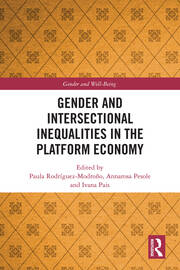
1st Edition
Gender and Intersectional Inequalities in the Platform Economy
Introduction
Paula Rodriguez-Modroño, Annarosa Pesole and Ivana Pais
PART 1: Digital labour platforms and intersectional inequalities
1. Access to Work in the Kenyan Digital Economy: Resilience, Resistance and Digital Intersectionality in the UPDATE Project
Claire Somerville, Agnieszka Fal-Dutra Santos, and Salome Bukachi in collaboration with UPDATE Team
2. The Digital Double Shift: How the Flexibility Myth and Therapeutic Maternalism Engender Platform Therapy
Livia Garofalo and Suisui Wang
3. Digital Platform Work and Gender Discrimination: an Analysis of the European Platforms Directive
4. The Impact of the Platform Economy on Gender and Social Inequalities in Eastern Europe: A Case Study of Moldova and Lithuania
Ligita Gasparėnienė, Rita Remeikienė, Dorin Vaculovschi, Liliana Staver and Ilona Michailovič
5. The Social Status of Platform Economy Work: Prestige and Social Value Dynamics and their Social Structuration
Christoph Lutz and Gemma Newlands
PART 2: Care and domestic work platforms
6. Domestic Work Platforms in the Global South: A State-of-the-Art Review and Lessons from Mexico
Fernanda Teixeira
7. Negotiating Working Conditions: The Case of Domestic Work Mediated by Digital Platforms in Argentina
Lorena Poblete, Ania Tizziani and Francisca Pereyra
8. Women Workers in India’s Digital/ Platform economy
Neha Arya and Abhishek Nemuri
9. Gendered Insecurity and the Informalisation of Work on Domestic and Care Platforms in Belgium
Milena Franke, Claudia Marà and Valeria Pulignano
10. The Platformization of care in Spain: Examining the Sustainability and Potential Gendered Impacts of Platform Models
Valentina Viego, Ángela Medina-Calvo and Paula Rodriguez-Modroño
11. Redefining Digital Labour Platforms Through a Technico-Organizational Approach: A Study of Care and Cleaning in French-Speaking Switzerland Through the Lens of Interfaces
Camille Budon, Jessica Pidoux and Núria Sánchez-Mira
12. Transformation and Platformization of Domestic Work in Italy: A Qualitative Case Study in Milan on Digital Labour Platforms and Other Digital Spaces
Beatrice Busi, Alina Dambrosio Clementelli and Annalisa Murgia
13. Conclusions
Ivana Pais, Paula Rodriguez-Modroño and Annarosa Pesole
Biography
Paula Rodríguez-Modroño, PhD in economics from Universidad de Sevilla (Spain) and MPhil in development studies from University of Cambridge, is Professor of Economics and Director of the Interdisciplinary Centre of Women's, Gender and Feminist Studies (CINEF) and the Master Programme for Gender and Equality at Universidad Pablo de Olavide, Sevilla.
Annarosa Pesole, PhD in economics from Università degli Studi di Milano Statale (Italy), is a labour economist specialised in new forms of digital labour and technological change. She is an expert consultant on digital and labour policies for the European Commission and the United Nations.
Ivana Pais is Full Professor of Economic Sociology at Università Cattolica del Sacro Cuore in Milan (Italy), where she directs the Transformative Actions Interdisciplinary Laboratory (TRAILab).
