




1st Edition
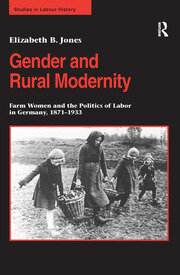
Gender and Rural Modernity Farm Women and the Politics of Labor in Germany, 1871–1933
By Elizabeth B. Jones
Copyright 2009
254 Pages
by
Routledge
254 Pages
by
Routledge
254 Pages
by
Routledge
Also available as eBook on:
By the end of the First World War, women's labor was viewed by contemporary observers as fundamental to the survival of family farms in Germany and consequently to the nation's economic and social stability. At the same time, however, the overburdening of farm women sparked increasingly acrimonious conflicts between young hired women, or Mägde, their employers, and state officials. The... Read more
Contents: Introduction: Gender and politics in the German countryside, 1871-1933; Surviving the family farm: women, work, and agricultural politics in the German Empire; Contesting the family farm: young women’s challenges to the rural ideal during the Kaiserreich; 'Compelling duty?': the First World War and the crisis of rural female youth, 1914 -1922; The campaigns to rationalize farm women’s work in Weimar Germany; The farm wife as preserver of the nation: gender and conservative agrarian politics in Weimar Germany; Conclusion: gender history, rural history, and the making of modern Germany; Bibliography; Index.
Biography
Dr Elizabeth B. Jones, Department of History, Colorado State University, USA
’This is a fascinating study which utilizes a range of official, published and archival sources and is sensitive to the need to give farm women some space to speak for themselves (where possible) and not be seen merely as subjects of contemporary debates or bystanders in political actions. ...Although it is in essence a local study, its subject matter and arguments make it relevant to major themes in agrarian history and women's history, as well as German history, and I would recommend it to anyone with an interest in any of these areas.’ Agricultural History Review ’... this book succeeds in challenging the conventional urban-rural construct by providing a persuasive account of "how farm women themselves shaped debates over their labor and the nation's future before, during and after the First World War" (p.2). ... It is to Jones's credit that she has been able to recover those lost voices and to fit them into more general debates about continuity and change in recent German history.’ Enterprise & Society ’Jones’ study succeeds admirably in substantiating her claim of the importance of the countryside in any consideration of German history. Well-grounded in the relevant historiography, it is strongest in its illumination of contemporary views on farm women’s productive labour... These women, almost invisible in prewar discourse, became so important to German agriculture that their overburdening came to be regarded as a threat both to the nation’s food supply and to its very existence.’ German History ’This is a groundbreaking work that enlarges our understanding, both of this large and previously little-known group of women and of the history of modern Germany and Europe.’ Central European History 'Overall, Jones makes a compelling argument for the importance of women's labor on German farms, and she presents substantial evidence that women both embraced change and attempted to create continuity. Gender and Rural Modernity is a valuable c
