



1st Edition
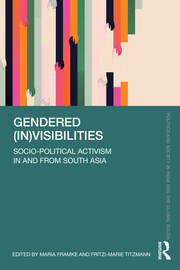
Gendered (In)visibilities Socio-Political Activism in and from South Asia
Introduction: Gendered (In)visibilities. An Interdisciplinary Approach to Activism
Maria Framke and Fritzi-Marie Titzmann
Part A: Historicising (In)Visibility
1) Rethinking Solidarities in Nationalist Struggles: A Case Study of South Africa and India
Kalpana Hiralal
2) Gender, nationalism and student activism: female-only students' associations in colonial Bengal (late 1920s)
Maria Tumiotto
3) Hidden Histories: Krishnabai Nimbkar and the Question of Rural Development in India
Maria Framke
4) Debating Patriarchy, Debating Feminism: Late 20th Century Telugu Discourse on the Women’s Question
A Suneetha
Part B: (In)Visible Modes of Contemporary Activism
5) Nuclear invisibilities: Feminised performativities of dissent in Koodankulam
Sonali Huria
6) Governing on the Margins: Gendered Processes of Invisibility and Women’s Political Activism in Rural Sri Lanka
Tara Quinn
7) The ‘Empowered’ mahila karyakarta: Gender and Party Politics in the Bharatiya Janata Party
Rashmi Singh
8) Local Lens, Global Vision: South Asian Women Architects Pioneering Critical Regionalism
Nadja-Christina Schneider
Biography
Maria Framke is a historian of modern South Asia at Rostock University, Germany. Maria’s research and publications cover the history of international organizations, imperial and nationalist politics and humanitarianism, development and gender in the 20th century.
Fritzi-Marie Titzmann is a scholar specializing in gender, media, and social movements, with a particular focus on contemporary South Asia. She holds a Ph.D. in South Asian Studies from Humboldt-Universität zu Berlin and has over 15 years of research and teaching experience.
“This volume is a very welcome addition to the literature on women and political movements in South Asia. With its framing of (in)visibilation and especially the rich case studies that span the colonial and the postcolonial period, drawing on a range of regionally and socially diverse locations, the volume will be of considerable interest to those working in the fields of history, the social sciences and gender studies.”
Mary E. John, formerly Professor and Director of the Centre for Women’s Development Studies, New Delhi, India.
“Gendered Invisibilities should be an essential reading for all scholars and activists engaged with South Asian women’s struggles against oppression and marginalization. The book explores women’s invisibilisation under the conjoint regimes of class, caste and patriarchy – articulating the subtle interconnections among the different social categories even while acknowledging their fluidity and porousness. The chapters investigate women’s autonomous movements as well as their presence in broad based ones. They simultaneously address their subordination and their agency. The book covers different spaces and times as well as issues of multiple varieties of exploitation and tyranny – by states, by right- wing forces, by families and by local depredations against environmental and community health and survival. In doing so, it retrieves important hidden histories.”
Tanika Sarkar, Professor, JNU, India.
“This ambitious work, spanning a century of women’s political activism, while truly bringing meaning to South Asia as a region, builds on shared histories and geographies, while emphasising distinctions and local specificities. As an empirically grounded work, it also serves as an urgent corrective to political narratives that have stubbornly resisted acknowledging women’s political engagements within and beyond movements, and national boundaries. Though it meticulously foregrounds feminist solidarities and multiple forms of political engagement, often of little known figures, and in less researched domains, it goes well beyond the modest goal of making women ‘visible’, breathing new life into conceptual categories and feminist method alike. This work importantly rewrites the meaning of women as agentive political beings in colonial and post-colonial South Asia.”
Janaki Nair, retd. Professor, Centre for Historical Studies, JNU, India.
