




1st Edition
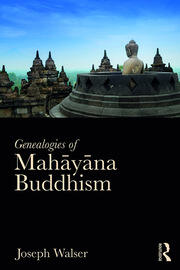
Genealogies of Mahāyāna Buddhism Emptiness, Power and the question of Origin
Acknowledgements
Part I: Genealogies of Mahāyāna
- Introduction: On Origins and Genealogies
- Mahāyāna in Retrospect: From My House to the Dalai Lama (looking back from 2017 – 1930)
- Assessing the Essence
- Tibet as Buddhist: Tracing the Lines of Power
- Emptiness and the Analytic of Power
- Inculcating Dispositions to Authority: the Kālacakra
- Mahāyāna in the Republic, Mahāyāna in the Empire: Tracing “Religion” from Republican China to the Early Qing Dynasty (1920’s – 1723)
- Religion vs. Superstition in 20th Century East Asia
- The Fin de Siècle Turning Point
- The Qing Imperium and the Usefulness of Mahāyāna
- The Yonghegong Temple in Beijing and the Political Work of Monuments
- Emperor Qianlong: the Tantric Initiate and the Tantric State
- Tantra, Emptiness and the Reincarnate Emperor/Lama, or why it’s never too late to have a venerable past.
- Yongzheng Emperor and the Great Ming Debate
- The Image of Emptiness across the Landscape of Power (China: 11th Cent. B.C.E – 15th Cent. C.E.)
- The Ancestor Image
- The Image of Emptiness: Di, Space and the Celestial Pole
- The Image of the Earth and control of the cults
- Exorcism and the State: When possession is nine-tenths
- Religion in the Service of Taxation
- Buddhist Exorcism and the Heart of Mahāyāna
- Conclusion
- Buddha Veda: an Indian Genealogy of Emptiness (20th century – 6th century CE.)
- Emptiness and Power in Orissa: From Mahima Dharma Sampradāya to Jagannātha of Puri
- Buddhism and Brahmanism in Maitrīpa (ca. 1010-1097 CE)
- Bhāviveka’s 6th Century Mahāyāna
- Bhāviveka, Mahāyāna and Yogācāra
- Bhāviveka, Mahāyāna and Brahmanism
- Preliminary Conclusion
- What did the text of the Perfection of Wisdom look like?
- The Versions
- The Quest for the Ur-Sūtra
- The Core Pericope
- The Ending
- Subhūti’s Non-Apprehension
- The Mindlessness Section
- The Message of the Original Perfection of Wisdom
- Mahāyāna
- Bodhisattvas
- What’s missing?
- Mahāyāna Sūtra as Palimpsest: Discerning Traces of the Tripiṭaka
- Beyond "origin" as mere event
- Heteroglossia and Textual Rationale
- Intertextuality and Adaptation in Buddhist Literature
- The Non-Apprehension section and its Intertexts
- Sermon on Selflessness?
- Nominalism?
- Cessation of Cognition
- Selflessness… but differently
- The Perfected as Untraceable
- Fearlessness
- Abhidharma echoes
- Conclusion: The Perfection of Wisdom
- Palimpsest Part Two: Brahmanical Writings on the Tripiṭaka
- The Importance of Incoherence
- The Context of Abhidharma Literature?
- The Context of Other Schools?
- The Context of Luminous Thought and Varieties of Unaware Thought
- The Context of Acitta Neither Existing nor Not Existing as Anti-Brahmanical Dependent Origination
- The Context of Absence of Mental Construction (avikalpa)
- Nirvikapla
- Brahmanical Intertexts and their Implications
- Placing Early Mahāyāna
- Placing the Perfection of Wisdom in the Early Mahāyāna Suite
- Mañjuśrī’s Inquiry Concerning the Office of the Bodhisattva
- Placing the Early Perfection of Wisdom
- Mistaken Sounds
- Subhūti’s Araṇavihāra: Preaching or Penetration?
- Emptiness, Brahmin Nuns, Tulkus and the Power of Possession
- Putting it together
- Conclusion
- On Sites and Stakes: Meditation on Emptiness and Imperial Aspirations
- Shifting Contexts, Shifting Interpretations
- The Uṇṇābhabrāhmaṇasutta and the Bṛhadāraṇyaka Upanișad on cosmic foundations
- The Horse Sacrifice
- Piling the Fire Altar and Legitimation Regress
- Buddhist Brahmins
- On Power and Reproduction
- Sovereign Echoes: on Manhood and Celibacy; On thrones and Crowns
- Buddhist Brahmodya as court debates
- The Mahāyāna Genealogy from The Vedas to the Sutras to Tantra to Zen
Part II: The Genealogy of the Perfection of Wisdom
Index
Biography
Joseph Walser is Associate Professor of Religion at Tufts University, USA.
"This book is a compelling argument to rethink the origins of Mahayana Buddhism. Approaching this perennial puzzle within Buddhist Studies from a different angle, tracing it from the present toward its genesis, Walser masterfully draws together material from a broad and complex cultural context to rethink the approach to understanding the earliest expressions of the idea of emptiness". Matthew Sayers, Lebanon Valley College Annville, USA.
"A bold new theory of what the Mahāyāna is and how it "began," Genealogies of Mahāyāna Buddhism is a paradigm shift in our understanding of one of the most important traditions of Buddhism. Written in clear and accessible prose, Walser's work is essential reading for anyone interested in the history of Buddhist thought." José Ignacio Cabezón, Dalai Lama Professor of Tibetan Buddhism and Cultural Studies, UC Santa Barbara, USA.
