




1st Edition
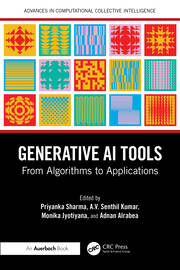
Generative AI Tools From Algorithms to Applications
1. The Expanding Horizon of Generative AI: Applications Across Diverse Fields
Ekta Gupta, Priyanka Sharma, and Nikhil Sharma
2. Generative AI Tools and the Marketing Industry
Surbhi Gosain and Shivani Sharma
3. A Comprehensive Review on Intrusion Detection Systems for Internet of Things: From Theory to Implementation Using Machine Learning, Deep Learning, and Generative AI Techniques
Naveen Saran, Nishtha Kesswani, and Ravi Saharan
4. Advancements in Chatbot Technology: A Comprehensive Overview of ChatGPT
Pooja Jain, Ankush Tondon, and Basant Agarwal
5. Precision Forecasting for Electric Vehicle Charging Infrastructure Planning in Sustainable Urban Mobility
Digambar Singh Govind and Manoj Fauzdar
6. A Hybrid Deep Learning-Based vs Generative AI for Intrusion Detection System in IoT
Monika Vishwakarma and Suparn Padma Patra
7. AI-Driven Harmony: Predictive Maintenance Unleashed with EV Integration in Distribution Networks
Yashvi Mudgal and Rajive Tiwari
8. Occluded Face Recovery Using Generative Adversarial Network (GAN)
Manisha Kumari Meena and Hemant Kumar Meena
9. Segmentation of Lung Regions from Chest X-Rays Using AI-Based Techniques
Sanjive Tyagi, Tarun Kumar, Govind Murari Upadhyay, Arun Kumar Uttam, Pramod Kumar Soni, and Anupam Agarwal
10. Conversational Intelligence at the Edge: ChatGPT Integration in IoT Ecosystems
Monika Jyotiyana, Monika Vishwakarma, and Usha Jain
Biography
Priyanka Sharma is recognized as being among the top 2% of scientists across the world, as declared by Stanford University and Elsevier. She is an active researcher, working as an assistant professor in the Department of Computer Science & Engineering, Swami Keshvanand Institute of Technology, Management & Gramothan, Jaipur, Rajasthan, India. She has guided various both undergraduate and postgraduate scholars. She is a member of the Institute of Electrical and Electronics Engineers (IEEE), the Association for Computing Machinery (ACM) and various professional societies. She has published more than forty research papers in national and international journals/conferences and book chapters, and has also edited four books. She has taken part in forums hosted by Infosys, TCS, Oracle, Wipro and IBM. Her particular area of interest is investigating the advancements in machine learning and deep learning applications. She has received accolades a number of times in a variety of fields, including designation as an active reviewer by some well-known journals.
Monika Jyotiyana is currently working as assistant professor in the Department of Computer Applications, Manipal University Jaipur, Rajasthan, India. She received her Doctoral degree and Master’s degree from Central University of Rajasthan, Rajasthan, India. She received her Undergraduate degree in 2010 from the Aryan International College Affiliated from the MDS University Ajmer, Rajasthan, India. Her research interests include medical image processing, machine learning, deep learning and neural networks. She has publications in various prestigious conferences, journals, books and book chapters.
A. V. Senthil Kumar is working as the principal of the Nehru Institute of Information Technology and Management, Coimbatore, India. He has worked as professor and director at the PG and Research Department of Computer Applications, Hindusthan College of Arts & Science, Coimbatore, Tamilnadu for more than 15 years and as a senior grade lecturer in CMS College of Science and Commerce for 14 years. To his credit, he has five years of industrial experience and three decades of teaching experience. He has also received his Doctor of Science (DSc. in Computer Science). He has to his credit 86 book chapters, 234 papers in international and national journals, and 85 papers in international and national conferences; he has also edited 17 books and 3 textbooks. He is an associate editor of IEEE Access and an editor-in-chief for many journals and a key member for India, Machine Intelligence Research Lab (MIR Labs). An editorial board member and reviewer for various international journals, he is also a committee member for various international conferences. To date, he has guided 16 PhD scholars; at present, he is guiding another 3.
Adnan Alrabea received his Dr. Eng. degree in 2004 from the Electronic and Communication Department, Faculty of Engineering, Donetsk University, Ukraine. He is a visiting associate professor and assistant dean of Prince Abdullah Bin Ghazi Faculty of Science and Information Technology at Al-Balqa Applied University, Assalt, Jordan. His research interests cover: analyzing the various types of analytic and discrete event simulation techniques; performance evaluation of communication networks; application of intelligent techniques in managing computer communication networks; and performing comparative studies between various policies and strategies of routing, congestion control, sub netting of computer communication networks. He has published around 30 articles in various refereed international journals and conferences covering: computer networks, expert systems, software agents, e-learning, image processing, wireless sensor networks and pattern recognition.
