




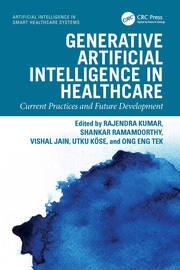
1st Edition
Generative Artificial Intelligence in Healthcare Current Practices and Future Development
Chapter 1 Transformative Influence of Explainable AI in Smart Healthcare
Moushumi Das, Shikha Tuteja, Ravinder Tonk, Raj Gaurang Tiwari, Ambuj Kumar Agarwal, and Kamolrat Intaratat
Chapter 2 Disease Diagnosis and Clinical Research Using Generative AI
C. Nirmala, M. Sridevi, G. Gnanamathy, S. Subriya, S. Saranyadevi, and M. Muthumani
Chapter 3 Transformative Impact on Disease Diagnosis Using Generative AI
Tinu, Archna Chaudhry, and Simriti Popli
Chapter 4 Exploring Digital Tools Utilizing Generative AI in Healthcare
Nancy Arya, Ankit Bansal, Rajendra Kumar, Kamolrat Intaratat, and Khar Thoe Ng
Chapter 5 Ethical Considerations in Generative Artificial Intelligence in Healthcare
Odangowei Inetiminebi Ogidi, Obienu Anayochukwu Chukwunonso, Hilda Chinwe Afakwu-Adimoha, and
Mukul Machhindra Barwant
Chapter 6 Navigating the Ethical Crossroads of Generative AI in Healthcare
Anjali Sharma, Mayank Aggarwal, and Jitin Khanna
Chapter 7 The Pinnacle of Disease Diagnosis through Generative Artificial Intelligence: Transforming Healthcare
Arpita Nayak, Ipseeta Satpathy, Vishal Jain, and Majidul Islam
Chapter 8 Exploring Generative AI and IoMT in Diabetes Prediction
Aman Anand, Rajendra Kumar, Neetu Singh, Bhumika Dutta, and Om Rajput
Chapter 9 Machine Learning Algorithms for Analyzing Medical Images and CT Scans
Dimple Thakar, Santushti Betgeri, Bhagyashree Amit Chougule, Monisha Mohan, Urvi Bhatt, and Pratik Sangani
Chapter 10 Integrity in Innovation: Harnessing Generative AI for Next-Generation Healthcare
Moushumi Das, Shikha Tuteja, Ravinder Tonk, Raj Gaurang Tiwari, and Piyachat Lomchavakarn
Chapter 11 Generative Adversarial Networks for Healthcare Applications....... 196
Shourya Kumar, Shreya Goel, Shikha Agarwal, Sanjay Kumar Sonker, Ankit Bansal, and Ruchi Bansal
Chapter 12 Innovations in Smart Healthcare: Integrating Generative
Artificial Intelligence with Federated Learning..............................224
Kamolrat Intaratat, Piyachat Lomchavakarn, Panicha Boonsawad, Karn Boonsiri, Korrakoch Kantaboon,
Duangkamol Intaratat, and Rajendra Kumar
Chapter 13 Generative Artificial Intelligence in Healthcare: Approaches and Applications
Ajay Sharma, Surbhi Gupta, Shubhra Dixit, and Sujit Kumar Jha
Chapter 14 Generative AI in Healthcare: A European Case Study
Rama Maliya, Niomi Samani, Tejas Uttare, Yash Gaur, Rajendra Kumar, Pradeep Chaintale, and Masanori Fukui
Chapter 15 Opportunities, Challenges, and Future Directions of
Generative Artificial Intelligence in Healthcare
Djamel Saba and Abdelkader Hadidi
Chapter 16 A Reassessment of Generative AI for Healthcare and Future Work Environments
Rinki Singh, Deepak Garg, Rajendra Kumar, and Sudan Jha
Biography
Dr. Rajendra Kumar is working as an Associate Professor at the Department of Computer Science & Engineering, School of Engineering & Technology, Sharda University. Dr. Kumar has 26 years of teaching and research. He is editor-in-chief of ADI Journal of Recent Innovations (AJRI), Indonesia, and also a reviewer of Medical & Biological Engineering & Computing (Springer Journal), and Expert Systems with Applications (a refereed international journal of Elsevier). He is a senior member of IEEE. He has chaired many sessions at international conferences and delivered keynote talks. He has published 5 textbooks, 8 edited books, 15 book chapters, 10 conference proceedings, 2 monographs and 4 patents. https://www.sharda.ac.in/faculty/details/rajendrakumar
Dr. Shankar Ramamoorthy an IITian with 34 years of academic and industry experience is Professor of Computer science at Galgotias University, Greater Noida, India. Dr. Shankar Ramamoorthy has spent a larger part of corporate life in companies like C.DOT, Bharti Group, Alcatel, Amdocs, Harman, UST Global, Ness Technologies to name a few in senior executive roles and created digital transformation pack to make students industry ready per top emerging IT trends @ 2030 using top 30 technologies guided by Gartners Hype Cycle. He has been in senior academic leadership roles in CMRIT & Presidency University before joining Sharda University as Dean. https://www.sharda.ac.in/faculty/details/shankarramamoorthy/
Dr. Vishal Jain is presently working as a Professor in the department of Computer Science & Engineering at Sharda University, Greater Noida, U.P. He has more than 17 years of experience in the academics. He has authored more than 100 research papers in reputed conferences and journals, including Web of Science and Scopus. He has authored and edited more than 45 books with various reputed publishers, including Springer, Apple Academic Press, CRC, Taylor and Francis Group, Scrivener, Wiley, Emerald and IGI-Global. His research areas include information retrieval, semantic web, ontology engineering, data mining, ad hoc networks, and sensor networks. http://www.sharda.ac.in/faculty/details/dr-vishal-jain
Dr. Utku Köse received a B.S. degree in 2008 in computer education from Gazi University, Turkey as a faculty valedictorian. He received an M.S. degree in 2010 from Afyon Kocatepe University, Turkey in the field of computer and a D.S. / Ph. D. degree in 2017 from Selcuk University, Turkey in the field of computer engineering. Currently, he is an Associate Professor at Suleyman Demirel University, Turkey. Kose also gave lectures at other higher education institutions such as Gazi University and Istanbul Arel University. He also works as a Visiting Researcher at the University of North Dakota, USA. With more than 300 publications his research interests include artificial intelligence, machine ethics, artificial intelligence safety, biomedical applications, optimization, chaos theory, distance education, e-learning, computer education, and computer science. https://www.utkukose.com/
Dr. Eng-Tek Ong is a highly experienced and accomplished professor at UCSI University, Kuala Lumpur, Malaysia. He holds a PhD from Cambridge University, UK. He has been awarded the Fundamental Research Grant Scheme (FRGS) three times by the Ministry of Education for his research on science process skills and inquiry learning in science for teachers. UNESCO Bangkok has also awarded him twice to undertake research on HIV-AIDS Preventive Education. He was the Chief Reviewer for CoSMEd 2021 and is an editorial member for a few journals, including Learning Science and Mathematics (LSM) Online Journal and Journal of Science and Mathematics Education in Southeast Asia. https://www.ucsiuniversity.edu.my/professor-dr-ong-eng-tek
