





1st Edition
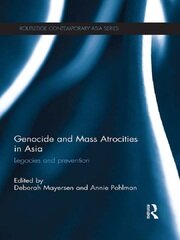
Genocide and Mass Atrocities in Asia Legacies and Prevention
Introduction Deborah Mayersen and Annie Pohlman Part 1: The Legacies of Atrocities in Asia 1. An Ongoing Legacy of Atrocity: Torture and the Indonesian State Annie Pohlman 2. International Civil Society as Agent of Protection: Responses to the Famine in East Timor Clinton Fernandes 3. Maximizing Transitional Justice Opportunities: The Case of East Timor’s CAVR Heather Castel 4. Transitional Justice Time: Uncle San, Aunty Yan, and Outreach at the Khmer Rouge Tribunal Alex Hinton 5. Humanitarian Intervention and the Legacies of Security Council (In)action: East Pakistan (1971) and East Timor (1976-1979) Phil Orchard Part 2: Preventing Genocide and Mass Atrocities in Asia and Globally 6. Political Realism, Sovereignty and Intervention: Is Genocide Prevention Really Possible in a World of Sovereign States? Paul Bartrop 7. Political Instability and Genocide: Comparing Causes in Asia and the Pacific and Globally Benjamin Goldsmith, Dimitri Semenovich and Arcot Sowmya 8. Discourses on Violence: Constraints and Challenges for Mediators in Asia Dale Bagshaw and Damien Coghlan 9. ‘Never Again’ or Again and Again: The Genocide Convention, the Responsibility to Protect and Mass Atrocity Prevention Deborah Mayersen 10. Conclusion Deborah Mayersen and Annie Pohlman
Biography
Deborah Mayersen is a Research Fellow at the Institute for Social Transformation Research, University of Wollongong, Australia. Her research focuses on the area of comparative genocide studies, including the Armenian, Cambodia and Rwandan genocides.
Annie Pohlman is Lecturer in Indonesian Studies at the University of Queensland, Australia. Her research interests include Indonesian history and politics, genocide and mass atrocities in Southeast Asia, gendered experiences of violence and torture.
