





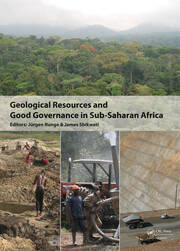
1st Edition
Geological Resources and Good Governance in Sub-Saharan Africa Holistic Approaches to Transparency and Sustainable Development in the Extractive Sector
Foreword
Holistic approaches to transparency and sustainable development in Sub-Saharan Africa: Background and objectives; J. Runge & J. Shikwati
Geological resources and governance
How geological resources can aid Africa’s development; J. Shikwati
An overview of geological resources in Sub-Saharan Africa: Potential and opportunities for tax revenue from the extractive sector; P. Buchholz & M. Sturmer
Transparency and the value chain in extractive industries in Central Africa; A. Bomba Fouda
Investments in the mining industries for sustainable development; E.P. Ambomo
International approaches to improve resource governance in Africa; M. Schnell & M. Grosmann
Case studies
Uganda’s oil boom: Potential and risks; H.G. Babies & B. Pfeiffer
World Bank’s failure in Chad-Cameroon oil project; G. Ngarsandje
Turning the curse into a blessing: A convenient Illusion. Lessons from the Nigerian EITI process; M. Muller
Geological resources and transparency in the Central African commodities sector—examples from Equatorial Guinea and the Central African Republic; J. Runge
Whither communities? Restorative justice in the Tiomin Kenya Ltd. titanium mining case; C.A. Khamala
Good governance, transparency and regulation in the extractive sector; S.V. Rungan, C. Musingwini & H. Mtegha
The impact of EITI and the role of civil society in Africa in promoting and advancing transparency in the extractives sector; M.-A. Kalenga & members of the EITI International Secretariat
Investment in extractive industries and sustainable development in Central Africa; Z. Tourere
Regional approaches and activities of the private sector (companies)
Regional organisations’ approach to mining and exploitation in Sub-Saharan Africa; H. Mtegha, C. Musingwini, S.V. Rungan & O. Oshokoya
Instruments and experiences to improve resource governance in a multinational context—cooperation with the Commission of the Economic and Monetary community of Central Africa (CEMAC); J. Runge
Corporate Social Responsibility (CSR) in Cameroon; E. Dibeu
Rating the social and environmental quality of commodities; R.D. Hasler
Artisanal mining, gender and HIV/AIDS
Artisanal mining activity—a benefit or a burden for sustainable development in Central Africa? A. Bomba Fouda
Institutional aspects of artisanal mining in forest landscapes, western Congo Basin; J. Schure, V. Ingram, J.C. Tieguhong & C. Ndikumagenge
Legal and fiscal regimes for artisanal diamond mining in Sub-Saharan Africa: Support for formalisation of artisanal diamond mining in Central African Republic; J. Hinton, E. Levin & S. Snook
Reflections on capacity building for women in small-scale mining within the CEMAC zone; I. Boukinda & J. Runge
Best practices working in partnership in response to HIV and AIDS in mine site Lake Zone in Tanzania; L. Ndeki, P. Sekule, K. Kema & F. Temu
HIV/AIDS in the informal mining sector evidenced by rapid antibodies tests—the Bossoui village case study (Lobaye, Central African Republic); J. Runge & C. Ngakola
Outlook
Conclusion: The urgent need to include African people—where do we go from here? J. Shikwati & J. Runge
Author index
Colour plates
Biography
Jürgen Runge is a Professor of Physical Geography and Geoecology at the Goethe-University Frankfurt, Germany. As an environmentalist and consultant he has worked for many years on the evolution of tropical landscapes and former and recent climate changes in lower latitudes. He is the editor of the series “Palaeoecology of Africa” and a member in several scientific editorial boards. The outcome of his studies has been used for regional planning (e.g. remote sensing, land use, infrastructure projects and management of natural resources). From 2007-2010 he was working for the German Technical Cooperation (GTZ) leading a subregional project on geological resources, transparency and good governance in Central Africa (CEMAC, Communauté Economique et Monetaire de l’Afrique Centrale).
James Shikwati is a Geographer and Economist and the founder and managing director of the Inter Region Economic Network (IREN) in Nairobi, Kenya. He is an internationally recognized expert for economic and development problems in African countries and has been mainly working on trade, environment and agriculture. He is also the editor of the online magazine "The African Executive". In 2008 Shikwati was appointed by the world economic forum to be one of the most influential ‘Young Global Leaders’
