




1st Edition
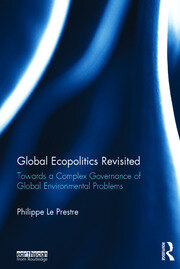
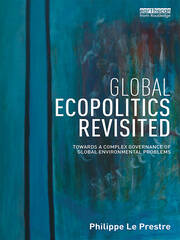
Global Ecopolitics Revisited Towards a complex governance of global environmental problems
Introduction: Challenging the doxa of global ecopolitics
- The injunction of the ecological crises
- International environmental governance beyond cosmopolitanism
- Bridging the science-policy divide
- The European Union in global environmental governance
- The power of the weak: developing countries in the global governance of climate change and biodiversity
- Towards fractal governance
Biography
Philippe Le Prestre is a professor of political science at Laval University (Quebec, Canada) where he specializes in international environmental politics. He was the founding director of Laval University’s Sustainable Development Institute (2005–11) and between 1995 and 1999 he chaired the environmental studies section of the International Studies Association.
"Le Prestre provides a refreshing exposé of the convenient fictions which underlie the largely US-centric study of global ecopolitics, and how they distract attention from the complex nature of global challenges more generally. He calls for a more comprehensive and interlinked approach to the study of global environmental politics, and IR more generally; borrowing from and applying complexity theory." – Peter Haas, Professor of Political Science, University of Massachusetts Amherst, USA
"A seasoned observer of global environmental politics, Le Prestre goes far beyond conventional wisdom to offer refreshingly alternative insights into the evolution of the field in this well-crafted treatise. This is an impressive work that captures multiple perspectives and channels them into a robust agenda for future scholarship." – Peter Stoett, Director, Loyola Sustainability Research Centre and Professor of Political Science/International Relations, Concordia University, Canada
"By questioning some apparently strong assumptions that structure the field of global environmental governance, Global Ecopolitics Revisited brings a clear added value and a welcome complement to existing textbooks. The author not only deconstructs common understandings of global environmental politics, but also proposes new thinking, tackling recent issues of global environmental governance with an innovative perspective based on complex systems and fractal governance." – Amandine Orsini, Professor of International Relations, Université Saint-Louis – Bruxelles, Belgium
