




1st Edition
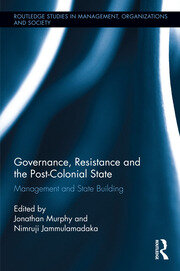
Governance, Resistance and the Post-Colonial State Management and State Building
1. Introduction (Jonathan Murphy and Nimruji Jammulamadaka)
Section I: Neoliberalism and the Post-Colonial State
2. Colonialism, Neoliberalism, Neocolonialism: The Struggle Continues – The Case of Kuttanad, India (Kuriakose Mathew)
3. Slaughtering of the Amazon: Greenpeace and the Transnational Beef Industry in Brazil (Marchus Vinicius Peinado Gomes)
4. Global Policy Networks: Non-state Actors and Local Development in Pakistan (Ghazal Zulfiqar)
5. Women, Work and T-Shirts: The High Cost of Cheap T-shirts in a Global Capital (Kamal Munir)
6. Financialisation and Global Corporate Governance: A Discussion of Cultural Tensions (Galit Ailon)
7. On the Geopolitics of Knowledge (Alex Faria)
Section II: Foment of Building the Post-Colonial State
8. Struggling for Survivability or Managing Governance? Resistance of the Jute Community of Bangladesh (Fahreen Alamgir)
9. Institutional Anchors and the Paradox of Intervention: Remobilizing Fighters in Post-war Sudan (Samer Abdelnour)
10. Corruption in Indian Local Governance as Resistance: A Post-Colonial Reading of the State (Arpita Mathur)
11. Corruption and State Building in South Africa (Ivor Chipkin)
12. Modes of Compromise and Negotiation in State Building: The Tunisian Islamist Perspective (Hela Yousfi)
13. Theorising the Post-Colonial State in Anti-Corporation Protest: Insights from India (Nimruji Jammulamadaka and Biswatosh Saha)
14. How does Dialogue Really Take Place in a Democratic Transition? The Case of Tunisia (Jonathan Murphy and Virpi Malin)
15. Conclusion (Jonathan Murphy and Nimruji Jammulamadaka)
Biography
Jonathan Murphy works as a scholar and practitioner in the areas of democratic governance and international management. He has led democratic development projects in more than 20 countries in Africa, Asia, Europe and the Americas, and has been a faculty member at Cardiff Business School in Wales as well as the University of Alberta, Canada. Currently, Jonathan is a UN official in Kiev, Ukraine.
Nimruji Jammulamadaka is an associate professor with the organization behaviour group at the Indian Institute of Management (IIM) Calcutta. She is also co-chair of the critical management studies division of the Academy of Management for 2016–2017, and the author of Indian Business: Notions and Practices of Responsibility.
