





1st Edition
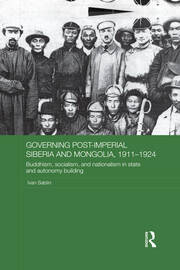
Governing Post-Imperial Siberia and Mongolia, 1911–1924 Buddhism, Socialism and Nationalism in State and Autonomy Building
Introduction
1. Demographics, Economy, and Communication in the Borderland, 1911–1917
2. Transcultural Spaces and Entanglements, 1911–1917
3. The Buryat National Autonomy, 1917–1918
4. Power Struggle in a Stateless Context, 1918–1919
5. The Mongol Federation and the Buddhist Theocracy, 1919–1920
6. The New Independent States, 1920–1921
7. The Buryat Autonomy in Transcultural Governance, 1921–1924
Conclusion
Biography
Ivan Sablin is an Associate Professor in the School of History at the National Research University Higher School of Economics, St Petersburg, Russia.
"The period from 1911 to 1924 in eastern Siberia is unique because of the explosion there of so many state-building and autonomy projects. Sablin’s study provides not only a guide to these projects, but analysis of the ideas and theories behind them. His research demonstrates how complicated governance can be in a transcultural space. The book offers 15 useful maps that outline the geography, economy, ethnicity, and religion of the region."
Melissa Chakars, St. Joseph’s University, Slavic Review
