




1st Edition
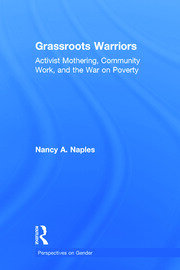
Grassroots Warriors Activist Mothering, Community Work, and the War on Poverty
By Nancy A. Naples
Copyright 1998
296 Pages
by
Routledge
296 Pages
by
Routledge
296 Pages
by
Routledge
Also available as eBook on:
Who are the grassroots warriors on the front lines of the war on poverty? Through in-depth interviews, Nancy Naples presents the voices of over sixty women--African American, Puerto Rican and white European American--who have fought for social and economic justice in the low-income neighborhoods of New York City and Philadelphia. These women, as community workers and activist mothers, contribute... Read more
PART I: INTRODUCTION 1. Women Warriors in the War on Poverty PART II: THE U.S. WAR ON POVERTY 2. Contradictions of New Careers 3. Community Action in Differing Political Contexts PART III: MOTIVATIONS AND INSPIRATIONS 4. Pathways to Community Work 5. Activist Mothering, Community Caretaking, and Civic Work PART IV: THE GENDERED POLITICS OF COMMUNITY WORK 6. Dynamics of Race, Class, and Feminist Praxis 7. Intergenerational Continuity of Community Work PART V: CONCLUSION: LESSONS FOR A RENEWED WAR ON POVERTY 8. Shifting Standpoints on Politics and the State APPENDICES A. Methodological Considerations B. A Demographic Profile of the Community Workers Interviewed C. Don't Bother Voting in Poverty Elections D. Amending the War on Poverty E. Permissable and Prohibited Activities PAAC 1966 F. Map of Philadelphia's Twelve Poverty Areas G. Maximum Participation Movement, Philadelphia 1966
Biography
Nancy A. Naples
"One hopes this book will serve as a lesson for a renewed "war on poverty." Upper-division undergraduates and above." -- Choice
"Grassroots Warriors, provides a welcome counterpoint to the harsh judgments of those who disparage poor women for lacking work and family ethics and illustrates instead how the community action programs provided women opportunities to develop skills that enhanced their abilities to contribute to their communities. Nancy Naples provides a theoretically insightful analysis of the progressive possibilities of anti-poverty policy." -- Jill Quadagno, Florida State University
"The book's major contribution is in providing the empirical material to suggest an alternative model of citizenship. Rather than identifying the model citizen as the "voter," the community "volunteer," or the aspiring politician, citizenship here is depicted as crossing the boundaries between paid and unpaid work, engaging with the caretaking work of the local community, and challenging the strictures of a deeply hierarchical society in all domains of life." -- Mobilization, Fall 2001
