





1st Edition
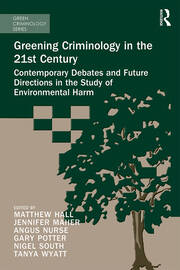
Greening Criminology in the 21st Century Contemporary debates and future directions in the study of environmental harm
Introduction: Green Criminology in the 21st Century
Matthew Hall
Jennifer Maher
Angus Nurse
Gary Potter
Nigel South
Tanya Wyatt
PART I - EXAMINING GREEN CRIMINOLOGY
Chapter 1: Carbon economics and transnational resistance to ecocide
Rob White
Chapter 2: Doing 'green criminology': methodologies, research strategies and values (or lack thereof?)
Matthew Hall
Chapter 3: Can the individual survive the greening of criminology?
Dominic A. Wood
Chapter 4: Transnational environmental crime: meeting future challenges through networked regulatory innovations
Julie Ayling
PART II – CASE STUDIES IN GREEN CRIMINOLOGY
Chapter 5: The animal other: legal and illegal theriocide
Ragnhild Sollund
Chapter 6: Environmental victimization: a case study of citizen’s experiences with oil and gas development in Colorado, USA
Tara O’Connor Shelley
Tara Opsal
Chapter 7: Pirates or protectors? A critical perspective on extreme environmental activism
Angus Nurse
Middlesex University London
Chapter 8: Eco-Crime and fresh water
Hope Johnson
Nigel South
Reece Walters
Chapter 9: The other side of agricultural crime: when farmers offend
Joseph F. Donnermeyer
PART III - QUESTIONS AND AGENDAS IN GREEN CRIMINOLOGY
Chapter 10: A new benchmark for green criminology: the case for community-based human rights impact assessments of REDD+ programmes
Malayna Raftopoulos
Damien Short
Chapter 11: Implementation and enforcement of environmental law: the role of professional practitioners
Grant Pink
Chapter 12: Examining secondary ecological disorganization from wildlife harms
Michael J. Lynch
Michael A. Long
Kimberly L. Barrett
Paul B. Stretesky
Chapter 13: Green cultural criminology, intergenerational (in)equity and ‘life stage dissolution’
Avi Brisman
Nigel South
Biography
Matthew Hall, Angus Nurse, Jennifer Maher
Green criminologists from all over the world have contributed to an outstanding piece of work that raises awareness of the importance of reducing environmental harm. In addition to scholars and students, the book should be read closely by policy makers who set priorities in the sustainable development of the world.
Gorazd Meško, Professor of Criminology, Faculty of Criminal Justice and Security, University of Maribor, Slovenia.
Rather than a specialist branch of what was once described as the ‘infelicitous science’, green criminology seems to gather the most felicitous moments in the history of the discipline: a focus on conducts that are harmful but are not regarded as criminal, the identification of powerful offenders, attention to interactions, including those between us and non-human animals. This book proves that criminology has still a tremendous repository of imagination to draw from.
Vincenzo Ruggiero, Professor of Sociology, Middlesex University, London
